


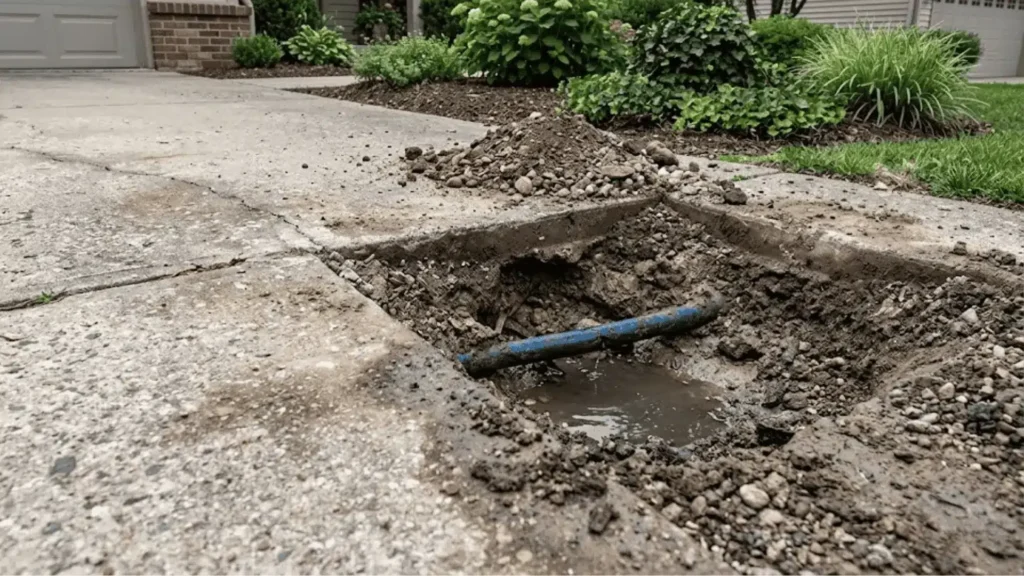
If The City of Calgary dug up your driveway, sidewalk or lawn to work on a water main or a water service line, The City is responsible for putting it back — at no cost to you, and to its former condition. What surprises most homeowners is not the bill. It is the wait, and the ugly black asphalt patch sitting in your driveway in the meantime.
We get calls about this every spring. The short version: the patch is not the repair, the repair is scheduled for a later season on purpose, and there is a good engineering reason for it. Here is the whole picture in plain language.
First, the invisible line that decides everything
Your water pipe has two owners, and the handover point is your property line.
The City puts it this way in its homeowner guide:
“The water service can be thought of in two sections: the first section, running from the water main to the property line, is owned and maintained by The City; the second section, running from the property line to the house is owned and maintained by the homeowner.”
So the pipe under the street and under the boulevard is The City’s problem. The pipe under your front yard, under your driveway and into your basement is yours.
There is one wrinkle worth knowing. The little shut-off valve for your house — the service valve — usually sits very close to the property line, and it is not always on The City’s side of it. The City owns and maintains that valve regardless of which side of the line it landed on. If a crew is digging around it, that is City work even if the hole is technically in your yard.
Second, a surprise: part of your driveway isn’t yours
This one catches almost everyone. The strip of your driveway that runs from the sidewalk out to the curb — what The City calls the driveway crossing — is not your property. It sits in the road right-of-way, which The City defines as including city streets and sidewalks, driveway crossings and wheelchair ramps, back lanes, and “the area between the property line and the sidewalk.”
You shovel it, you park on it, you paid to have it poured. It is still public land. That is why The City can cut it without asking you, and also why The City is the one who has to put it back.
So who actually pays? Three scenarios
1. The City did the digging. The City pays for the restoration. Its Water Services group runs a property rehabilitation process specifically for this, and the commitment is explicit: “We are committed to completing projects to the highest quality; including returning your property to its former condition.” When the work wraps up, you should get a door hanger explaining what happens next.
2. A private contractor did the digging. Different answer. The City is clear that “if a private construction company completed the construction work, they will be responsible for the property repair work.” If a utility or a developer’s crew opened the trench, your conversation is with them, not with 311. Anyone cutting into the road right-of-way needs an Excavation Permit under the Streets bylaw 20M88, and the permit holder carries a two-year maintenance obligation on the backfill — so if the patch sinks next summer, they are still on the hook.
3. The break was on your side of the property line. Then it is yours. The City’s guidance is blunt: you arrange the contractor and you pay for the repairs. Under the Water Utility Bylaw (40M2006), an owner has to keep their service connection in good repair, and The City can require repairs to be made within 15 days before issuing a remedial order. One more thing worth knowing before you assume otherwise: these repairs “aren’t typically covered by a basic homeowner’s insurance policy.”
Why you get asphalt first, and concrete much later
This is the part that generates the most frustration, and it is the part that is actually good practice.
When a trench is backfilled, the soil underneath has not finished settling. Pour a concrete slab onto ground that is still moving and you get exactly what you would expect: cracking, sinking, and a second repair. So The City places a temporary asphalt patch to make the area safe, then waits.
How long? The City’s own pages give two different answers, so plan for the longer one.
The property rehabilitation page says:
“Replacement of temporary asphalt patch with permanent concrete will be scheduled by Mobility for the following construction season (which typically means at least 12 months) to allow the ground time to settle and go through one season or freeze/thaw cycles. This reduces the chances that the concrete will crack or sink.”
The water outage page is more conservative: “we schedule the sidewalk for concrete replacement following a full freeze-thaw cycle, typically two years after repair.”
Realistically, budget two winters. In Calgary, freeze-thaw is the whole point — the ground here lifts and drops through the cold months, and a full cycle is what proves the backfill has found its level. Rushing it guarantees a cracked slab, and cracked slabs behave badly from there. We have written about why concrete cracks and what to do about control joints if you want the detail.
The timelines, collected in one place
| What | How long |
|---|---|
| Property rehab season | May to September, material-dependent |
| City response to a property rehab request | within eight weeks inside that seasonal window |
| Request received after the end of September | carried forward to the following May |
| Temporary asphalt replaced with permanent concrete | following construction season — at least 12 months, and often closer to two years |
| If a Water Services repair fails again | you can request rework within two years of the original repair |
| A planned water main replacement on your street | typically three to five weeks of construction |
| Notice before your water is shut off | at least a day in advance |
| Standard construction hours | 7 a.m. to 7 p.m., Monday to Saturday |
That two-year relapse window is worth circling. If the concrete or the lawn The City restored has sunk, cracked or heaved since, you can ask for it to be redone. Most people never find out that option exists.
What The City will not restore
A few things fall outside the commitment, and they are the ones that cause the arguments:
- Private irrigation lines. The City does not track or document them, so “it is up to the property owner to fix any disturbances made to the lines.”
- Flowers and shrubs planted in a utility right-of-way. Lawn damage gets restored. Your perennials do not.
- Anything you built in the right-of-way that was not supposed to be there in the first place.
If you have an underground sprinkler system anywhere near the boulevard, flag it to the crew before they dig. Once the trench is open, the conversation is much harder.
Restoration is not the same as a damage claim
This distinction saves a lot of wasted time. Restoration is The City putting back what it removed, and it happens automatically through Water Services. A claim is you asking The City to compensate you for a loss, and it is a separate, much narrower process.
For water main breaks specifically, The City’s position is that it will generally not pay. Under section 528 of the Municipal Government Act, a municipality is not liable for damage arising directly or indirectly from roads or from the operation of a public utility, absent negligence. The City states the consequence plainly: if it has done what is reasonable given the condition of the utility at the time, “we will not be found to be negligent. Therefore The City will not consider these types of claims.”
So if your basement flooded because a main let go, a claim is a long shot. If your driveway was cut to fix that main, restoration is owed to you regardless. Ask for the right thing and you will get a much faster answer.
What to do, in order
- Find out who dug. City crew or private contractor? The door hanger, the signage, or a call to 311 will tell you. This determines who you chase.
- Photograph everything before the patch goes in — the slab edges, the lawn, the sprinkler heads, the curb.
- Submit a property rehabilitation request if The City did the work and nothing has been scheduled. Requests landing after September roll to May.
- Keep the file open. Note the date of the original repair so you can use the two-year relapse window if the restoration fails.
- Mind the patch through winter. Temporary asphalt holds water and holds de-icer. Keep the edges clear and avoid piling salt-laden snow on the surrounding concrete, which is a reliable way to turn a cosmetic problem into surface spalling.
Where this page stops
This is general information about how restoration after municipal water work normally runs in Calgary. It is not legal advice, and it does not cover every situation — easements, private utility agreements and insurance policies all have their own rules, and The City’s processes can change. For your specific address, 311 is the authoritative answer. For lead service line replacement in particular, The City describes it as a shared responsibility with the homeowner but does not publish cost-sharing figures, so call rather than assume.
When it makes sense to do your own
Sometimes waiting two winters for a strip of City concrete is not the right answer — especially if the rest of your driveway was already due for replacement, or if the patch sits in the middle of a slab you were planning to redo anyway.
In that case, pouring the whole surface at once usually costs less than paying for a patch now and a replacement later, and you get a driveway that matches instead of a quilt of three different ages of concrete. The one thing to confirm first is where your property line falls, because the driveway crossing portion stays The City’s to restore even if you replace everything behind it.
That is a conversation worth having before anyone orders concrete. As a division of Omega 2000, we have been patching, matching and replacing Calgary driveways through a lot of freeze-thaw seasons, and we are happy to walk the site and tell you honestly whether to wait for The City or get on with it. Have a look at our concrete repair and replacement work, and if you are keeping an existing slab through another winter, our winter concrete maintenance guide covers how to protect it.
Frequently asked questions
Does The City of Calgary pay to fix my driveway after a water main repair? Yes, if City crews did the work. Water Services restores the affected property to its former condition at no cost to the homeowner. If a private contractor opened the trench, that contractor is responsible instead.
How long before the temporary asphalt is replaced with concrete? The City schedules permanent concrete for the following construction season, which it describes as at least 12 months, and its water outage guidance says typically two years after the repair. The delay lets the backfill settle through a full freeze-thaw cycle.
Who owns the water line under my driveway? The City owns and maintains the section from the water main to your property line. Everything from the property line into your house is yours, including the pipe under your front yard and driveway.
Is the end of my driveway really public property? The portion between the sidewalk and the curb — the driveway crossing — sits in the road right-of-way, which is public land, even though you maintain it day to day.
What if the City’s repair sinks or cracks later? You can request rework if restoration done by Water Services has relapsed within two years of the original repair. Note the original repair date so you can reference it.
Will my home insurance cover a repair on my side of the property line? Usually not. The City notes that water service repairs on private property aren’t typically covered by a basic homeowner’s policy. Check your own wording before assuming.
Sources
- The City of Calgary, Water construction property rehabilitation: https://www.calgary.ca/water/water-utility/water-construction-property-rehab.html
- The City of Calgary, Water service lines in Calgary: https://www.calgary.ca/water/water-utility/water-service-lines-calgary.html
- The City of Calgary, Rights-of-way: https://www.calgary.ca/utilities/rights-of-way.html
- The City of Calgary, Damage claims: https://www.calgary.ca/appeals/damage-claims.html