

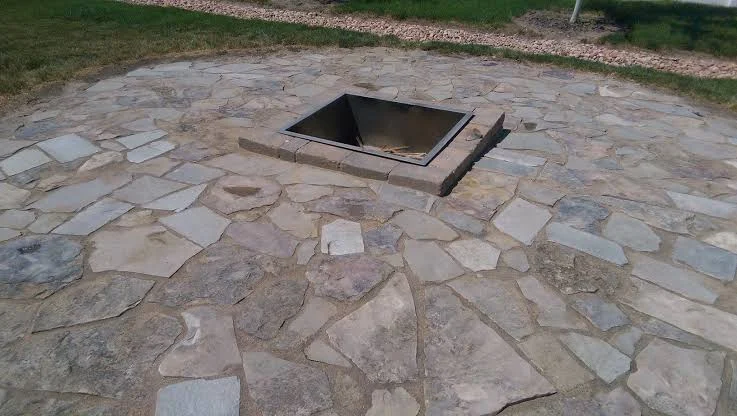
If you’ve been sketching a built-in fire feature for the back corner of a Calgary yard — the kind with a poured surround, a bench seat and a proper hearth instead of a rusting steel bowl on the grass — the first number you need isn’t a price. It’s two metres.
That’s the clearance the City of Calgary requires, and it quietly rules out a surprising number of the spots people have already picked. Get the location right and everything else is design. Get it wrong and you’ve poured a permanent structure in a place you can’t legally light.
Here’s what the City’s rules actually say, why concrete and open flame need a layer between them, and what genuinely moves the number on your quote.
Start with the two-metre rule, not the design
The City’s requirement is direct: fire pits must be at least two metres away from your property line, house, garage or fence. Not two metres from one of those things — two metres from all of them. On a standard inner-city lot with a detached garage and a fence on three sides, the compliant zone can be smaller than the patio you were planning to put the pit in the middle of.
There’s a second clearance that has nothing to do with distances on a plan: fire pits must not sit under any trees, branches, plants or other materials that can catch fire. A mature spruce or a low-hanging poplar branch overhead disqualifies an otherwise legal spot, and trees grow into that clearance over the years.
Before any concrete is designed, walk the yard and mark the two-metre offsets from the fence, the house and the garage. Whatever shape is left is the shape you’re working with.
How big the fire can be — and how tall the pit can be
Two separate limits apply, and people usually only hear about one.
The fire itself has a size cap. The City states that all fires in your fire pit must be kept to a reasonable size, which it defines as one metre high and one metre wide. That’s a generous fire, but it’s a real ceiling, and it sets the useful inside diameter of the pit: building a two-metre-wide fire bowl invites a fire you aren’t allowed to have.
The structure has its own limit. The City’s fire pit handout says backyard fire pits must be built into the ground, in a fire-proof container that does not exceed 0.75 metres in height, or sit on a non-combustible material such as brick or stone. For a concrete feature, that height limit is the one that shapes the design — a tall, dramatic fire column isn’t the brief. A low poured surround, a seat wall set back from it, and a non-combustible hearth under the whole thing is.
If you want a portable fire bowl on a deck instead, the City allows that provided it sits on brick or stone and not directly on the wood.
The screen almost nobody buys
A mesh screen — a “spark guard” — is required on wood-burning fire pits to cut down on embers and sparks escaping. The City also specifies the mesh: the openings must not be greater than 1.24 cm across.
This matters at the design stage, because a screen has to actually fit. A custom-poured pit with an unusual opening often ends up with no screen available for it — a compliance problem, not an aesthetic one. Decide the opening size and shape around a screen you can buy or have fabricated, before the forms go up.
When you’re actually allowed to have a fire
Calgary restricts the hours. The City’s fire pit page quotes the rule as: no person shall ignite or allow an outdoor fire to burn on a premises between 12:00 a.m. and 10:00 a.m. from Monday to Friday, or between 1:00 a.m. and 10:00 a.m. on Saturday or Sunday. In plain terms, fires are out by midnight on weeknights and 1 a.m. on weekend nights, and you can’t light one before 10 in the morning.
Two more standing conditions: all fires must be continually supervised, and you need a way to put out the fire close at hand. Smoke and noise complaints fall under the City’s smoke bylaw and Community Standards Bylaw, which is worth knowing if your compliant two-metre spot still puts the smoke plume on a neighbour’s deck.
Fire bans will change the answer a few times each summer
Calgary runs three escalating levels, declared by the Calgary Fire Department. An advisory (yellow) flags moderate risk and asks for extra caution. A restriction (orange) signals rising danger and prohibits certain activities. A ban (red) temporarily bans types of fire use, and the City says that may include the use of fire pits, barbecues and other forms of open flames.
The Fire Department weighs the fire index rating, water supply conditions under the Water Utility Bylaw 40M2006, and Special Air Quality Statements of 7 or above. Fines for violating a fire ban range from $500 to $5000.
Two practical notes. First, levels change quickly, so check the City’s Fire Bans and Advisories page or call 311 before lighting rather than relying on what was in force last weekend — as of the City’s September 17, 2026 update, no advisory, restriction or ban was in place for Calgary. Second, the same page notes that fireworks, pyrotechnics and open flames are not allowed at any time without a permit regardless of a fire ban, and it doesn’t spell out how that interacts with a backyard pit. If you’re planning anything beyond a conventional wood fire — a gas burner insert, for instance — confirm it with 311 first.
Why you can’t just pour concrete and light a fire in it
This is the part that separates a fire feature built properly from one that looks great for two seasons.
Concrete and direct flame are a poor pairing, and the reason is water. Concrete always holds some moisture inside it. Research at the U.S. National Institute of Standards and Technology on concrete at high temperature describes what happens as heat drives inward: free water starts evaporating rapidly just above 100 °C, and chemically bound water begins releasing when the interior reaches roughly 180 °C. If that vapour can’t escape fast enough, pressure builds inside the concrete.
When the pressure wins, you get spalling — concrete breaking away from the surface in flakes or chunks. In NIST’s testing, the violent version happened at around 250 °C measured 25 mm below the surface, with spalling observed across a range of roughly 200 °C to 325 °C. A wood fire sits well above those temperatures.
The counterintuitive finding is the useful one: denser, less permeable concrete was more prone to this, not less, because the vapour has nowhere to go. So “we’ll just use a stronger mix” is not a fix. The fix is a liner — firebrick, a steel fire ring, or a purpose-made insert — so the flame never touches the structural concrete, plus a design that doesn’t trap the heat against a single face.
That’s why a properly quoted concrete fire pit has a liner line item. It isn’t an upsell. It’s the part that keeps the feature from popping its surface, which is the same mechanism behind the surface damage covered in our concrete spalling repair guide.
What Calgary winters do to the surround
The fire is a summer problem. The surround is a year-round one. A fire pit sits in the middle of a hearth slab that goes through our full freeze-thaw cycle — water soaks in, freezes, expands, and works the surface loose — while also being heat-cycled from the middle outward every time you use it.
Two things handle most of it. The first is joint layout: a hearth slab around a fire feature needs its joints planned so the inevitable movement happens where you decided it would, which is the whole logic of our guide to control joints. The second is seasonal care, especially keeping de-icing products off decorative concrete — the approach we lay out in winter concrete maintenance.
What actually drives your quote
Roughly in order of how much they move the number:
- Access. Whether a machine and a concrete truck can reach the back yard, or whether everything comes through a gate by wheelbarrow. This is usually the single biggest swing.
- Whether the hearth slab already exists. Adding a fire feature to a sound existing patio is a different job from pouring the patio and the feature together.
- The liner and burner. A firebrick or steel-lined wood pit and a gas-fed insert with a supply line are very different scopes.
- Site preparation and drainage. Base depth, how the ground sits, and where water goes once it’s shed off the hearth.
- Finish. A broom-finished surround, an exposed aggregate hearth, a stamped border or an integrally coloured seat wall are all available; the finish and any seat wall forming drive labour.
- Seating and extras. Poured benches, a wood store, a counter run, or built-in lighting each add scope.
- Season. Late-season work in Calgary carries cold-weather protection costs that mid-summer work doesn’t.
Anyone who quotes a built-in fire feature from a photo, without seeing the access or the yard, is guessing.
Get a Straight Answer and a Fair Number
Not every yard should get a built-in fire pit, and we’ll tell you if yours is one of them. If your compliant two-metre zone is a one-metre strip behind the garage, or the only clear spot sits under a mature tree, a well-set portable bowl on a stone or brick pad is the honest recommendation — and it costs a fraction of a poured feature.
If the space does work, we’d rather show you the real envelope on site than sell you a rendering. Walk the yard with us: we’ll mark the setbacks, tell you what fits, and give you a number that already includes the liner and the base rather than discovering them later. Start with our concrete furniture and custom feature work, or see how a fire feature sits within a wider concrete patio build. As a division of Omega 2000, we’d rather lose a job than pour one in the wrong place.
FAQ
How far does a fire pit have to be from the fence in Calgary? At least two metres. The City requires fire pits to be a minimum of two metres from your property line, house, garage and fence, and they can’t be located under trees, branches, plants or other materials that can catch fire.
Do I need a permit for a backyard fire pit in Calgary? The City’s fire pit guidance sets rules on location, size, screening, fuel and hours, but does not describe a permit for a conventional backyard wood fire pit. It does say fireworks, pyrotechnics and open flames need a permit at any time, and it doesn’t detail how that applies to a pit, so call 311 before building anything beyond a standard wood-burning feature.
Will a concrete fire pit crack from the heat? It can, if the flame reaches the concrete. Heat drives moisture inside concrete into vapour, and when that vapour can’t escape, the surface breaks away. Research at the U.S. National Institute of Standards and Technology recorded this happening around 250 °C just below the surface, across a range of roughly 200 °C to 325 °C, and found denser concrete more susceptible rather than less. A firebrick or steel liner between the fire and the structure is what prevents it.
What happens to my fire pit during a fire ban? Under a red-level ban, the City says the restriction may include the use of fire pits, barbecues and other open flames. Fines for violating a fire ban range from $500 to $5000, so check the City’s Fire Bans and Advisories page or call 311 before lighting.
Sources
- Fire pit safety, The City of Calgary: https://www.calgary.ca/safety/fire-pits.html
- Fire pit safety handout, Calgary Fire Department: https://www.calgary.ca/content/dam/www/programs-services/public-and-personal-safety/fire-safety/fire-safety-in-your-home/cfd-fire-pit-safety.pdf
- Fire Bans and Advisories, The City of Calgary: https://www.calgary.ca/safety/fire-bans.html
- High-Strength Concrete at High Temperature — An Overview, Long T. Phan, National Institute of Standards and Technology: https://tsapps.nist.gov/publication/get_pdf.cfm?pub_id=860408