

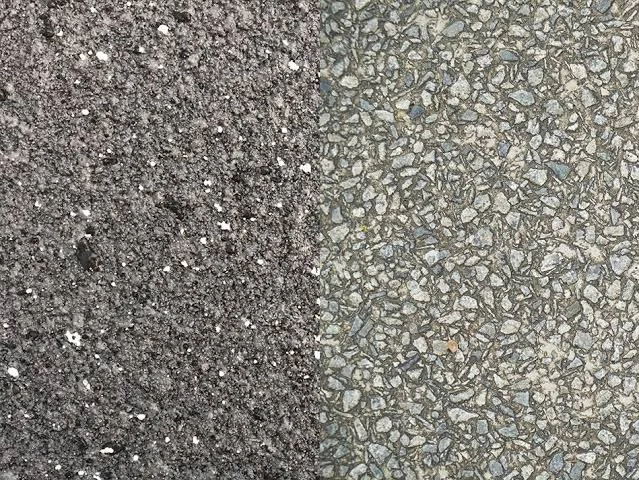
Resurfacing costs a fraction of replacement. That is why everybody asks about it first, and why contractors get asked to resurface things that should not be resurfaced.
The honest answer is that resurfacing is an excellent solution for a specific set of problems and a waste of money for everything else. Here is how to tell which one you have.
What resurfacing actually is
Resurfacing bonds a new cementitious layer — typically a polymer-modified overlay — over existing concrete. Done properly on a suitable slab, it produces a new surface with a new finish, and it can carry colour, texture or a stamped pattern.
What it does not do is add structural capacity. An overlay is a wear surface. It relies entirely on the slab underneath being sound.
That single fact decides everything else in this article.
The five checks
Run these five in order. If the slab fails any of the first three, resurfacing is not the answer.
1. Is the slab structurally sound?
Look for cracks that go all the way through, sections that move independently when you step on them, or a slab that has broken into distinct pieces.
An overlay bonded across a moving joint will crack in the same place, usually within the first winter. You will have paid for a surface that reproduced the problem it was supposed to hide.
Our guide to foundation crack types and when to worry covers how to read what a crack is telling you — the same principles apply to flatwork.
2. Has it settled or heaved?
If a driveway slopes toward the house, if slabs sit at different heights, or if a section has lifted, the problem is under the concrete.
An overlay follows the shape of what it sits on. Resurfacing a settled slab gives you a settled slab with a nicer finish and the same drainage problem.
Settled slabs may be candidates for lifting rather than replacement — that is a third option worth pricing.
3. How deep is the surface damage?
This is where most Calgary driveways land.
Surface scaling — the flaking and pitting caused by de-icing salt attacking the surface paste — is often exactly what resurfacing is for, provided the concrete below the damage is intact. Our step-by-step guide to spalling repair explains how to gauge the depth.
The rough test: if damage is confined to the top few millimetres and the aggregate below is still locked in place, an overlay has something to bond to. If aggregate is loose or the damage extends deeper, it does not.
4. Is the drainage right?
If water pools on the slab or runs toward the house, an overlay will not fix it. In fact it can make it slightly worse by adding thickness.
Correcting drainage means correcting the grade, which usually means replacement.
5. How old is it, and what do you want from it?
A slab with fifteen good years behind it and sound structure is a fine candidate for a resurface that buys another decade. A slab at the end of its service life is money better spent on replacement.
Where each option wins
| Resurfacing | Replacement | |
|---|---|---|
| Cost | Substantially less | Substantially more |
| Time on site | Days | A week-plus including cure |
| Fixes structural cracking | No | Yes |
| Fixes settlement or slope | No | Yes |
| Fixes surface scaling | Yes | Yes |
| Design options | Colour, texture, patterns | All of the above plus new layout |
| Expected service life | Shorter, and depends on the slab below | Full new service life |
| Winter durability | Good if properly specified and sealed | Best |
The Calgary-specific catch
Overlays in this climate live or die on two things.
Bond preparation. The existing surface must be properly profiled and clean. An overlay applied over a sealed, dirty or poorly prepared slab will delaminate — and it will delaminate in sheets, usually in spring.
Freeze–thaw and de-icer. The same salt that destroyed the original surface will attack an overlay. An overlay specified for a warmer climate will not survive here.
This is why a resurfacing job is more about the contractor than the product. Ask specifically how they profile the surface, what overlay system they use, and what the sealing schedule is afterwards.
On sealing, our comparison of penetrating versus film-forming sealers for the Calgary climate is the relevant read — the sealer choice matters more on an overlay than on original concrete.
When resurfacing is the clearly right call
- Surface scaling or pitting on a structurally sound slab
- Cosmetic tiredness on concrete that still drains correctly
- A pool deck or patio you want to change the look of
- Interior floors where the slab is sound
- A garage floor with surface wear but no cracking through
When it is not
- Any slab with cracks through the full depth
- Anything that has settled, heaved or lost its slope
- Concrete that is spalling deeply enough to expose or loosen aggregate
- Slabs at the end of their service life
- Anywhere the drainage needs correcting
FAQ
Can you resurface a concrete driveway in Calgary? Yes, when the slab underneath is structurally sound and still drains correctly. Surface scaling from de-icing salt is one of the most common and most suitable reasons to resurface. Structural cracking, settlement or slope problems are not.
How much cheaper is resurfacing than replacement? Meaningfully cheaper — resurfacing avoids demolition, disposal and full replacement volume. The exact ratio depends on the condition of the slab and the overlay system. Get both priced on your actual concrete rather than budgeting off a general figure.
How long does concrete resurfacing last? It depends on the slab below, the overlay system, the quality of the surface preparation, and the sealing schedule. A properly prepared overlay on sound concrete, sealed on schedule, lasts many years. A poorly prepared one fails in a season.
Will resurfacing hide cracks? Only cosmetically, and only temporarily, if the crack is still moving. A working crack telegraphs through an overlay. Cracks have to be assessed and addressed before an overlay is considered.
Can you resurface in the winter in Calgary? Overlays have temperature and cure requirements. Most resurfacing work is scheduled in the warmer months. Interior work is less constrained.
Is resurfacing worth it on a very old driveway? Often not. If the slab is at the end of its service life, an overlay adds cost to concrete that will need replacing anyway. Have it assessed rather than assuming.
Not sure whether your concrete can be saved? Calgary Concrete Services assesses the slab before quoting anything — including telling you when resurfacing is not the right call. Send photos of the worst areas and we will tell you which option you are actually looking at.