


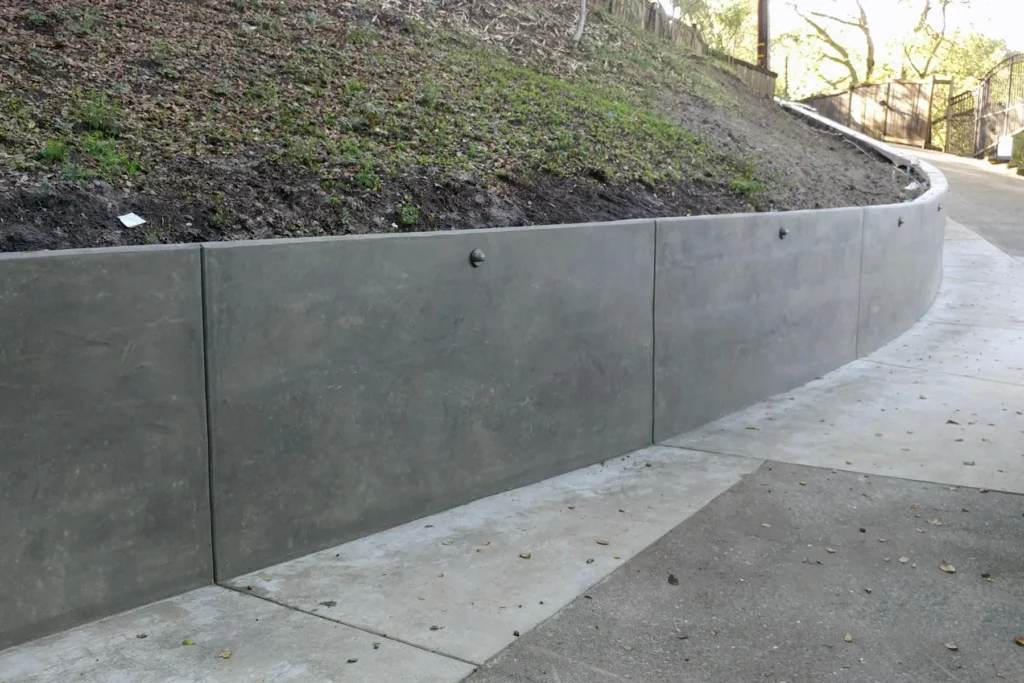
Most concrete retaining walls in Calgary land somewhere between $20 and $45 per square foot of wall face, installed. For a typical backyard wall — say 30 feet long and 3 feet tall, which is 90 square feet of face — that works out to roughly $1,800 to $4,000. Taller walls cost more per square foot, not less, because the engineering, the footing and the drainage all scale up faster than the concrete does.
That’s the short answer. The longer answer is that two walls of the same size on the same street can be priced thousands of dollars apart, and it usually comes down to three things: how tall it is (which decides whether the City needs to see it), what’s behind it, and how the water gets out. Here’s how each one moves the number.
What the price actually covers
A retaining wall is not a fence with concrete in it. It’s a structure holding back tonnes of wet soil that freezes and thaws all winter, so the parts you can’t see are most of what you’re paying for.
| Wall type | Typical installed cost per square foot of face | Notes for Calgary yards |
|---|---|---|
| Poured concrete | $20–$45 | Strongest option, cleanest look, best for straight runs and taller walls |
| Large concrete blocks | $20–$45 | Fast to install, heavy equipment needed on site |
| Modular interlocking block | $15–$35 | Common landscape option, best on lower walls |
| Concrete masonry (cinder) block | $20–$35 | Needs a proper core fill and reinforcement to last |
| Precast panels | $25–$40 | Quick install where access allows |
Those figures are North American cost-guide ranges, and they line up with what we see quoted around Calgary. Pricing is often given per linear foot instead — for walls in the 3-to-6-foot range, that translates to roughly $60 to $270 per linear foot for poured concrete, which is a wide band precisely because height matters so much.
The other line items that show up on a real quote:
- Excavation — roughly $130–$230 per cubic yard of material moved
- Drainage (gravel, weeping tile, filter fabric) — about $10–$30 per linear foot
- Engineering drawings, when required — commonly billed at $100–$220 per hour
- Permit fees — the City of Calgary’s retaining wall building permit is $202 plus an $8.08 safety codes council fee, $210.08 total
- Backfill and disposal — hauling old material away and bringing clean fill in
The height that changes everything: 1.2 metres
This is the number to know before you get quotes. In Calgary, a building permit is required when a wall retains 1.2 m (4 ft) or more of soil — and, importantly, when the combined height of all retaining walls and garden boxes within 1 m (3 ft 3 in.) of each other reaches 1.2 m. Two stacked 2-foot walls a metre apart are treated as one 4-foot wall.
A few practical consequences:
- Under 1.2 m: usually no building permit, and the wall is a landscape-scale job. This is where most backyard walls sit, and where costs stay predictable.
- At or over 1.2 m: permit required, and the design has to be prepared by a professional engineer registered in Alberta. Expect engineering fees, a site plan, a cross-section drawing showing the footing and drainage, and about 7 days for the permit to come back. The permit stays valid 180 days.
- A development permit may also be needed if the wall’s location or design doesn’t fit the land use bylaw — for example, sitting where a setback doesn’t allow it.
There’s a second rule that catches people: guards. Under the City’s regulation bulletin for retaining walls, a guard is required where the top of the wall sits 600 mm or more above the adjacent ground and the wall is at or near a public way. On a single-unit home, that guard needs to be at least 900 mm high (1,070 mm where the drop is more than 1,800 mm). Budget for it — a railing on top of a wall along a sidewalk is not an optional aesthetic choice.
If your yard drops more than about four feet, ask your contractor early whether the fix is one tall engineered wall or two shorter terraced ones. Terracing sometimes avoids the permit threshold entirely, and sometimes doesn’t — because of the combined-height rule above. It’s a five-minute conversation that can change the budget by thousands.
Why drainage is the line item worth paying for
Here’s the thing that kills retaining walls in Calgary: water that can’t get out.
Soil behind a wall soaks up snowmelt and rain. If that water has nowhere to go, it sits against the back of the wall and pushes — and when it freezes, it expands and pushes harder. That’s what makes a wall lean, bulge, or crack across the face. It’s the same freeze-thaw pressure that shows up in foundation cracks around Calgary homes, just applied sideways.
A properly drained wall has three things behind it:
- Free-draining gravel against the back of the wall, instead of the clay that came out of the hole
- A perforated drain pipe (weeping tile) at the base, sloped to daylight or to a place the water can safely go
- Filter fabric between the gravel and the soil, so silt doesn’t clog the whole system in three years
That package adds $10–$30 per linear foot. Skipping it saves a few hundred dollars and costs you the wall. When we’re asked where to trim a retaining wall budget, drainage is never the answer — shortening the wall or simplifying the finish is.
What a Calgary build actually looks like
Timeline. Most residential walls take 2–5 days from excavation to cleanup. Terraced or engineered projects run 1–2 weeks. Add permit time on top if the wall is over the threshold — roughly a week for the building permit, longer if a development permit is involved.
Season. Walls go in from spring through fall. Frozen ground makes excavation slow and expensive, and concrete needs protection to cure properly in cold weather. A wall poured in late October isn’t impossible, but it costs more and needs blankets and heat. If you’re planning for next summer, quotes booked in late winter usually get better scheduling.
Access. This is the sleeper cost. If a machine can reach the work area, excavation and material handling go quickly. If everything has to come through a 3-foot gate by wheelbarrow, labour hours climb fast. Tell whoever is quoting exactly what the access looks like — it’s the single most common reason two quotes come back hundreds of dollars apart.
Lifespan. A properly built and drained concrete retaining wall lasts 50 to 100 years. Wood is the cheapest to install and by far the shortest-lived, especially in our wet-dry-freeze cycle. That gap is the real argument for concrete: you’re not buying a wall for this decade, you’re buying one for the next owner too.
Keeping the wall alive after it’s built
Concrete retaining walls are close to maintenance-free, with two exceptions worth putting in your calendar.
Watch the drainage outlet. Once a year, check that the drain pipe outlet at the base of the wall isn’t buried, blocked by leaves, or grown over. That one habit prevents most long-term wall problems.
Be careful with de-icing salt. Salt thrown on steps and walkways above a wall ends up in the soil behind it and on the face below it, and salt is hard on concrete surfaces. Our guide to winter maintenance for new concrete covers what to use instead — the same rules apply to walls as to driveways.
Fine hairline cracks in a poured wall are normal and usually cosmetic; concrete shrinks a little as it cures, which is why control joints get placed deliberately. Cracks that are widening, walls that lean forward, or a wall bulging in the middle are different — that’s a drainage or structural problem, and it’s worth having looked at before winter rather than after.
Frequently asked questions
How much does a retaining wall cost in Calgary? Budget roughly $20–$45 per square foot of wall face for concrete, installed. A 30-foot-long, 3-foot-tall wall typically lands between about $1,800 and $4,000. Height, access, drainage and whether engineering is needed move that number more than anything else.
Do I need a permit for a retaining wall in Calgary? Yes, if the wall retains 1.2 m (4 ft) or more of soil — including the combined height of walls and garden boxes within 1 m of each other. The permit costs $210.08 with the safety codes fee, takes about 7 days, and requires drawings prepared by an engineer registered in Alberta.
Can I build a retaining wall myself? Low landscape walls under about 2 feet, sure. Once a wall is holding back real soil pressure, the footing, reinforcement and drainage all have to be right, and mistakes show up as a leaning wall two winters later — usually more expensive to fix than to have built properly.
Do I need a railing on top of my retaining wall? If the top of the wall is 600 mm or more above the ground beside it and the wall is at or near a public way, a guard is required — at least 900 mm high on a single-unit home, and 1,070 mm where the drop exceeds 1,800 mm.
How long does a concrete retaining wall last? 50 to 100 years when it’s drained properly. Drainage, not concrete thickness, is what usually decides whether a wall reaches that.
Is a poured wall or a block wall better? For anything tall, straight, or carrying a load above it — a driveway, a patio, a shed — poured concrete is stronger and looks cleaner. Block is quicker and fits curved landscape walls well. On a low garden wall the difference matters much less than the drainage behind it.
Getting a number for your yard
Every sloped lot is different, and photos of the slope plus a rough length and height are usually enough for us to give you a realistic range before anyone comes out.
We build residential and commercial walls across Calgary, Airdrie, Cochrane and Okotoks, and as a division of Omega 2000 we’ve got the forming and foundation crews to handle the tall engineered walls as well as the small backyard ones. Have a look at our retaining wall services and send us the height you’re dealing with — the first thing we’ll tell you is whether you’re above or below that 1.2 m line, because everything else follows from it.
External references: The City of Calgary, Fences and retaining walls and Regulation Bulletin RB06-051, Building Permit and Guard Requirements for Retaining Walls; HomeGuide, Concrete Retaining Wall Cost.