


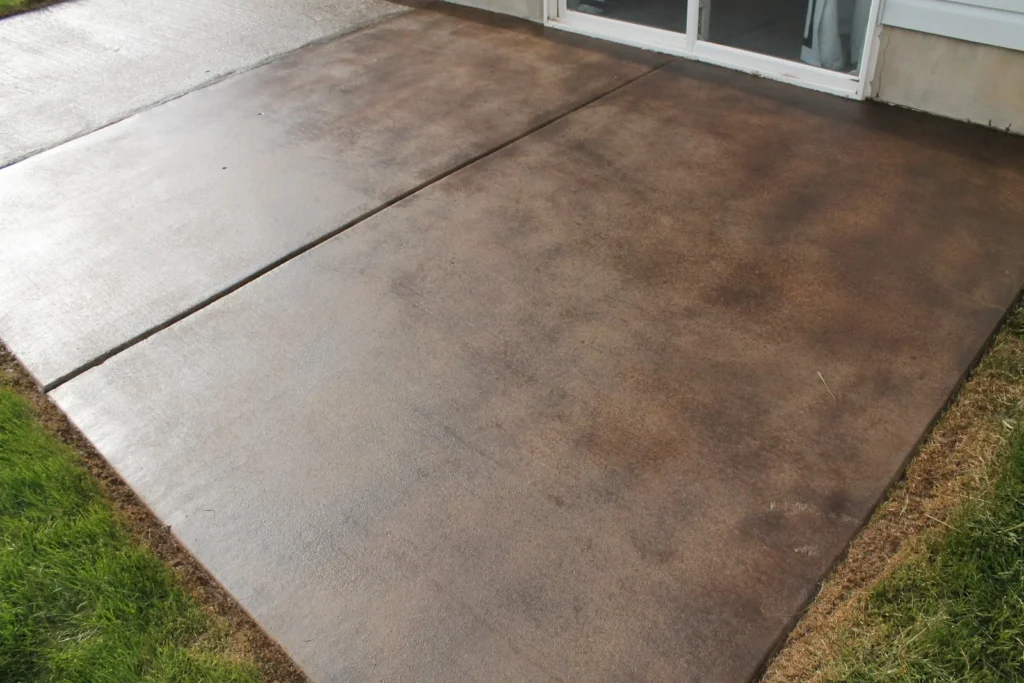
Staining a concrete patio, basement floor or garage slab in Calgary generally lands in the same range as other decorative concrete finishes — HomeStars’ 2026 Calgary price guide puts decorative finishes at $8 to $26 per square foot, and North American industry pricing for staining specifically runs from about US$3 to US$6 per square foot for a simple single-colour job up to US$16 to US$25 and beyond for hand-applied, multi-colour work. Where your project falls depends far less on the colour you pick than on what shape the slab is in before anyone opens a can.
That last part is the whole article, really. Staining is a finish, not a repair. On a sound slab it is one of the best-value upgrades available. On a slab that is already flaking, it is money spent on making a problem more colourful.
Here is how to tell which one you have, and what the job actually costs.
What you’re paying for
When a quote comes back, most of the number is labour and prep — not stain.
| Stage | What happens | Why it moves the price |
|---|---|---|
| Assessment | Someone looks at the slab, checks for flaking, cracks and old sealer | A previously sealed or painted slab has to be stripped first |
| Cleaning and prep | Degreasing, grinding or stripping, repairing cracks | The single biggest swing factor in any quote |
| Stain application | One or more colours, applied and neutralized | Multiple colours and patterns multiply labour hours |
| Sealing | Protective sealer over the finished stain | Included in most quotes; typically US$1–$3 per square foot on its own |
A basement floor that has never been coated and just needs a clean and a single water-based colour is at the cheap end. A 1970s garage slab with a flaking paint layer and three oil stains needs grinding, patching and a decision about whether staining is even the right call — and it prices accordingly.
Rough project sizes, using published North American figures: a small 10 ft × 10 ft patio typically runs US$300 to US$1,000; a larger 16 ft × 18 ft patio US$860 to US$2,900; a single driveway US$1,600 to US$7,200. Treat those as shape-of-the-number guidance rather than a Calgary quote — Canadian pricing, local labour rates and the condition of your particular slab all shift it, which is why anyone giving you a firm price over the phone without seeing the concrete is guessing.
Acid stain vs water-based stain, in plain language
These are two genuinely different products, and the difference matters more for outdoor Calgary concrete than most sales pages let on.
Acid stain (sometimes called chemical or reactive stain) doesn’t sit on the surface — it reacts chemically with the lime in the concrete and becomes part of it. The result is mottled, variegated, earthy: browns, tans, soft blue-greens, terracotta. Every slab reacts a little differently, so no two floors look the same. That is either the appeal or the problem, depending on whether you want a predictable result.
- Colour range: narrow. Earth tones, essentially.
- Look: organic and marbled, like aged stone.
- Durability: excellent, because the colour is chemically bonded into the concrete rather than lying on top of it.
- Predictability: low. You get a sample, not a guarantee.
Water-based stain is a pigment that penetrates into the surface pores rather than reacting with them. It comes in a far wider palette — greys, charcoals, blues, greens, near-anything — and can be applied as a translucent wash or an opaque, uniform colour.
- Colour range: wide.
- Look: more even and controllable.
- Durability: very good. It penetrates, so it doesn’t chip or peel the way paint does.
- Predictability: high, which is why it’s usually the choice when a colour has to match something.
Neither one is a coating. That’s the important distinction: because both penetrate, neither can peel off in sheets the way epoxy paint on a garage floor does after a hard winter. What protects both of them is the sealer on top, and in Calgary the sealer is the part that needs attention.
Does stained concrete survive a Calgary winter?
Yes — with one honest qualification.
The stain itself is not what fails in our climate. Colour that has penetrated or chemically bonded into the slab does not care about cold. What fails is either the sealer (which wears and needs refreshing) or the concrete underneath (which spalls if it wasn’t placed or maintained for freeze-thaw).
That second one is the real risk, and it’s worth being blunt about. If your patio or driveway already has flaking, pitting or surface scaling, staining it will not fix that, hide it, or slow it down. You’ll have a coloured, flaking slab. Fix or replace the surface first — our step-by-step guide to concrete spalling repair for homeowners walks through how to tell surface-level scaling from something structural.
For a sound slab, outdoor stained concrete in Calgary is entirely durable. The maintenance rhythm is:
- Reseal outdoor stained concrete every 2 to 3 years. Published guidance ranges from every 1 to 3 years; our chinook cycles and salt exposure put Calgary at the frequent end of that.
- Indoors, a sacrificial wax or floor finish over the sealer takes the daily wear, and you refresh the wax rather than the sealer.
- Keep de-icing salt off it. This is the single most useful thing a homeowner can do. Salt is harder on Calgary concrete than the cold is — we cover the seasonal routine in our guide to winter concrete maintenance.
- Shovel rather than chip. Metal blades scratch sealer, and scratched sealer is where water gets in.
Sealer choice matters here too. Penetrating and film-forming sealers behave very differently over stained concrete in a freeze-thaw climate, and the wrong one can trap moisture; we compare them in the best concrete sealers for Calgary’s climate.
When your slab isn’t a good candidate
Being straight about this saves people money. Staining is usually the wrong answer when:
- The surface is already spalling or scaling. Stain doesn’t bind loose material.
- There’s old paint, epoxy or a film sealer on it. It can be stripped or ground, but that prep can cost as much as the staining.
- The concrete is brand new. New slabs need to cure fully before staining — plan on roughly a month, and ask your installer for their specific timeline.
- There are large repairs or patches. Patch material takes stain differently than the original slab. It will show. Sometimes that’s charming; usually it isn’t.
- You want one exact, uniform colour and the slab is old. Age, previous sealers and patching all affect how stain takes. Water-based gives more control, but an old slab is never a blank canvas.
For an outdoor surface where the concrete is already rough, a resurfacing or a different decorative finish may deliver more for the money — exposed aggregate is a common alternative for Calgary patios and walkways.
How long the job takes
Most residential staining is a one to three day job including drying time, plus curing time for the sealer before furniture goes back. The sequence is usually:
- Day 1 — clean, strip or grind, repair
- Day 2 — apply stain, neutralize if acid stain, rinse and dry
- Day 3 — seal, then keep traffic off for the time the sealer requires
Outdoors, the weather runs the schedule. Staining and sealing need dry conditions and reasonable temperatures, which in Calgary means the realistic window is roughly late spring through early fall. A September booking is a normal booking; a mid-October one depends entirely on what the sky is doing.
Questions Calgary homeowners ask
How much does it cost to stain concrete in Calgary? Decorative concrete finishes run about $8 to $26 per square foot in Calgary according to HomeStars’ 2026 price guide, and North American pricing specific to staining spans roughly US$3 per square foot for simple single-colour work to US$25-plus for hand-applied multi-colour designs. Slab condition and prep drive the difference more than colour choice does.
Is stained concrete cheaper than replacing the slab? Almost always — when the slab is sound. Staining refinishes what’s there. Replacement is a full tear-out and pour. But if the concrete is failing, staining postpones a replacement rather than avoiding one.
Can you stain a concrete driveway in Calgary? Yes, and it holds up if the slab is in good shape and the sealer is maintained. Driveways see the most de-icing salt and the most freeze-thaw of anything on a property, so expect resealing at the frequent end of the 2-to-3-year range.
How long does stained concrete last? The colour is permanent — it’s penetrated or chemically bonded into the concrete, so it can’t chip or peel like paint. What needs renewing is the sealer over top, every 2 to 3 years outdoors.
Can I stain concrete myself? You can, and DIY saves the labour portion. The catch is that the two things most likely to go wrong are prep and neutralizing acid stain, and both are hard to undo once dry. On a small basement floor with a single water-based colour, it’s a reasonable weekend project. On a visible patio with an acid stain, a mistake is permanent.
Will it hide cracks and stains? Mottled acid stain camouflages minor surface variation well. It won’t hide structural cracks, oil stains that haven’t been degreased out, or patches. Deal with those first — including oil stains on a driveway, which need to come out before any colour goes on.
Getting a real number for your slab
The honest answer to “what will it cost” starts with someone standing on your concrete. Square footage sets the base; the condition of the surface, whether anything has to come off first, and how many colours you want set everything above it.
We’re a division of Omega 2000, and we’d rather tell you your patio needs repair before it needs colour than sell you a finish that won’t last. If you’re weighing it up, get a free quote on concrete staining — send a few photos of the slab, including any spots where it’s flaking, and we’ll tell you straight whether staining is the right call or whether your money is better spent somewhere else first.
Sources
- HomeStars — How Much Does a Concrete Contractor Cost in Calgary? (updated 2026): https://www.homestars.com/flooring-tiles/price-guides/concrete-contractor-cost-calgary
- Concrete Network — Cost to Stain Concrete: https://www.concretenetwork.com/stained-concrete/pricing.htm
- HomeGuide — How Much Does it Cost to Stain Concrete Floors? (2026): https://homeguide.com/costs/cost-to-stain-concrete