

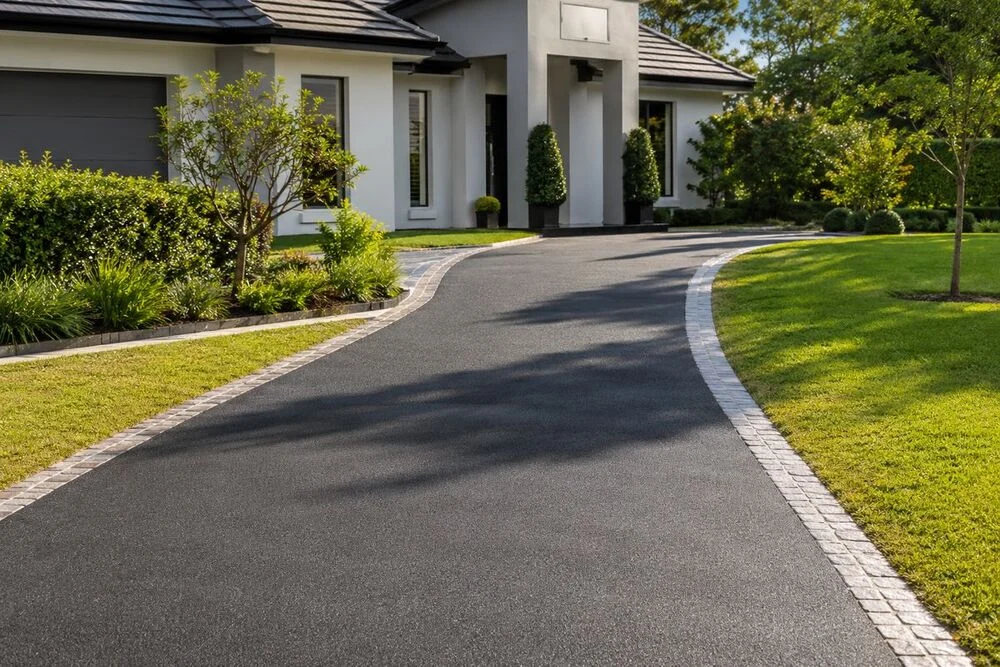
If you have watched a January chinook roll in over the ridge, turn your street into slush by two in the afternoon, and freeze it solid again by nine that night, you already understand the hardest question about a Calgary driveway. It is not which surface looks better on the day it goes in. It is which one is still flat and intact after a decade of that.
Most comparisons of the two materials are written for anywhere. This one is written for here, because the number of times a year your driveway crosses the freezing point is the single biggest difference between how these two surfaces behave in Calgary and how they behave in Vancouver or Toronto.
Calgary’s real number is 128 freeze-thaw cycles a year
A freeze-thaw cycle is one trip across the freezing point and back — water in the surface thaws, expands when it refreezes, and pushes outward on whatever is holding it. Repeat that enough times and any paved surface starts coming apart.
The City of Calgary tracks this directly. Its climate hazards review reports that in 2022, “117 freeze thaw cycles occurred, below the 30-year average of 128.” The same report counts “54 chinook days, higher than the average of 46 chinook days per year.”
A 30-year average of 128 freeze-thaw cycles means your driveway crosses zero roughly every third day across the year. And 46 chinook days means a large share of those crossings are not gentle seasonal transitions but sharp swings inside a single afternoon. Calgary does not have a winter that freezes in November and thaws in March. It has a winter that freezes and thaws over and over, which is the condition both of these materials find hardest.
One note on the numbers, because you will see different ones quoted. The City’s longer-range projections report works from a modelled annual baseline of 107.4 cycles for 1981 to 2010, rather than the 128 observed average. Two datasets, measured two ways, and we would rather show you both than average them into one tidy figure.
What each material actually does when the temperature crosses zero
The two surfaces fail in completely different ways, and the difference comes down to what holds them together.
Asphalt is aggregate held in a petroleum binder — essentially a flexible mat. That flexibility is a real advantage against ground movement, which Calgary’s clay soils deliver plenty of. The trade-off is that the binder changes with temperature and with age. Research on pavement performance notes that environmental exposure oxidizes asphalt binders and makes them brittle, and that this oxidation runs faster in porous mixes, leading to particle loss and raveling — the gradual shedding of loose aggregate that turns a smooth black driveway into a gritty grey one. Heat works the other direction: a warm binder softens, which is why a hot August day can leave a kickstand dent or a tire scuff in asphalt that will not come out.
Concrete is aggregate locked in a cement paste — a rigid slab. It will not soften in August and it will not dent under a trailer jack. What it does instead is crack, which is why it is poured with deliberate joints in the first place. Those joints are not defects; they are where the slab is told to move so it does not choose its own line. Our guide to control joints walks through how that is laid out and what spacing is appropriate.
There is a useful comparative figure on this. A federal study of environmental effects on pavement found that for flexible pavements in service 15 years under normal traffic, “36 percent of total damage is related to environmental factors,” while the figure for rigid pavements is 24 percent. That research was done on highways rather than driveways, and highway traffic is nothing like yours, so treat it as a directional finding rather than a promise. But the direction is consistent with what we see in Calgary back lanes: weather does proportionally more of the damage to asphalt than it does to concrete.
How often will you be maintaining it?
This is where the two materials genuinely part ways, and it is the part most homeowners are not told about before they sign.
Asphalt is designed around periodic resurfacing. The surface treatments that keep it going have documented service lives, and they are short. Federal pavement preservation data puts crack sealing at 0 to 4 years of extended pavement life, fog seal at 4 to 5 years, chip seal and microsurfacing both at 3 to 8 years, slurry seal at 4 to 7 years, and a thin overlay at 3 to 23 years. The same report is candid that none of the agencies studied used a formal method to determine these figures, so they are approximate — but the pattern is unmistakable. Asphalt maintenance is a repeating expense measured in single-digit years.
Concrete’s equivalent treatments last longer. The same dataset puts joint sealing at about 4 years and diamond grinding — essentially a mechanical resurfacing — at 4 to 17 years. More to the point, a residential concrete driveway in good condition does not need a scheduled surface treatment at all. It needs sealing on a sensible interval and it needs the winter care any concrete needs in this climate, which we cover in our note on winter concrete maintenance.
The honest summary: asphalt costs less to install and more to keep. Concrete costs more to install and asks less of you afterward. Which of those is the better deal depends entirely on how long you are staying.
What the climate is projected to do
If you are choosing a surface you intend to keep for 25 years, the forecast matters as much as the history.
The City’s projections report expects a slight increase in winter freeze-thaw cycles by the 2050s, then a slight decline by the 2080s as overall warming takes hold. Annual cycles are projected to fall more noticeably — from a 107.4 baseline toward a median near 83.5 in the 2050s and 64.1 in the 2080s — because the shoulder seasons will simply have fewer days that drop below zero.
The part that does not change is the chinooks. The report describes them as “a significant driver of Calgary’s freeze-thaw cycles in the winter” and says they “are not expected to change significantly with climate change.” So the mild seasonal freeze-thaw may ease off over the coming decades, but the violent mid-winter swing — the one that does the most damage to a driveway — is staying. Choose accordingly.
Where asphalt is genuinely the better choice
We pour concrete for a living, so take this in the spirit it is offered: there are situations where asphalt is the right answer and we will tell you so.
If you are selling within a few years and the existing surface is simply ugly rather than failing, asphalt gets you a clean, uniform black driveway for less money, and you will not be the one paying for the resealing cycle. If your driveway is long and rural and you are covering a lot of square footage on a tight budget, the installed-cost gap compounds in asphalt’s favour. If your ground is actively moving and you are not prepared to deal with the base properly, a flexible mat will tolerate that movement better than a rigid slab will, at least for a while.
What asphalt cannot do is hold a decorative finish or stay crisp at an edge. It comes in one colour and one texture.
Where concrete earns the difference
Concrete earns its premium in three places. It holds its shape under point loads, so trailer jacks, motorcycle stands and dumpster corners do not leave permanent impressions. It holds an edge, which matters where a driveway meets a sidewalk, a garage apron or a landscaped bed. And it can be finished — which is the whole reason most of the driveways we are asked about are concrete rather than asphalt.
That finish range is real: a broom finish for traction, exposed aggregate where you want the stone in the surface to carry the look, or stamped concrete where you want pattern and texture. None of that is available in asphalt at any price.
What actually drives the price difference
We are not going to publish a per-square-foot number for your driveway, because the figure that matters is yours and it depends on things we would need to see. What we can tell you is what moves it.
For both materials: total area, demolition and haul-away of the old surface, how good the existing base is and how much has to be rebuilt, equipment access, and whether the job can be done in one mobilization. Narrow side yards, steep approaches and no truck access all cost real money on either surface.
For concrete specifically: thickness, reinforcement, the finish you choose, how much edge and transition detail there is, and whether steps or a landing are part of the scope. Decorative finishes cost more than broom. A driveway with four curves and three transitions costs more per square foot than a rectangle.
For asphalt specifically: depth of the mat, the base, and the schedule on which you will be resealing it afterward — which belongs in your comparison even though no quote will include it.
Get a Straight Answer and a Fair Number
Here is how we would like this conversation to go. Tell us how long you plan to be in the house, what the existing driveway is doing now, and whether appearance matters to you or you just need a flat surface that works. If the answer points to asphalt, we will say so, and you will have lost nothing but a phone call.
If it points to concrete, we will come look at the base, the drainage and the access, and give you a number that accounts for what is actually there rather than a rate off a chart. Calgary Concrete Services is a division of Omega 2000, and you can see the scope of what we do on our concrete driveways page.
FAQ
Which lasts longer in Calgary, concrete or asphalt? Concrete, in most residential situations. Calgary’s 30-year average of 128 freeze-thaw cycles a year is hard on both, but asphalt’s binder oxidizes and becomes brittle with exposure and needs repeating surface treatments measured in single-digit years, while a sound concrete driveway needs sealing and winter care rather than scheduled resurfacing.
Is asphalt cheaper? To install, yes, usually by a meaningful margin. Over 20 years the gap narrows or reverses, because the resealing and resurfacing cycle is a recurring cost. Compare total cost over the time you intend to own the house, not the installed price alone.
Does asphalt handle Calgary’s ground movement better? It tolerates movement more forgivingly, because it flexes rather than cracks. That is a genuine advantage on unstable ground. The better fix in either case is a properly prepared base, which is where most driveway failures in this city actually begin.
Can I put concrete over my existing asphalt driveway? Not as a shortcut. Asphalt is a flexible surface and pouring a rigid slab on top of it means the slab inherits every soft spot and movement underneath. The old surface comes out and the base gets assessed first.
Why does my new concrete have lines cut into it? Those are control joints, placed deliberately so the slab cracks where you chose instead of where it decides. Spacing them correctly is part of the design, not an afterthought.
Will a chinook damage a new driveway? A chinook is the condition that stresses a driveway most, because it drives a full thaw and refreeze inside a day or two. A new pour needs its protection period respected before it faces one, and both surfaces benefit from drainage that moves meltwater off rather than letting it sit.
Sources
- City of Calgary, Climate Hazards: 1993-2022 trends and 2022 year in summary
- City of Calgary, Climate Projections for Calgary (January 2024)
- U.S. Federal Highway Administration, Pavement Preservation: Treatment Performance
- U.S. Federal Highway Administration, Impact of Environmental Factors on Pavement Performance