


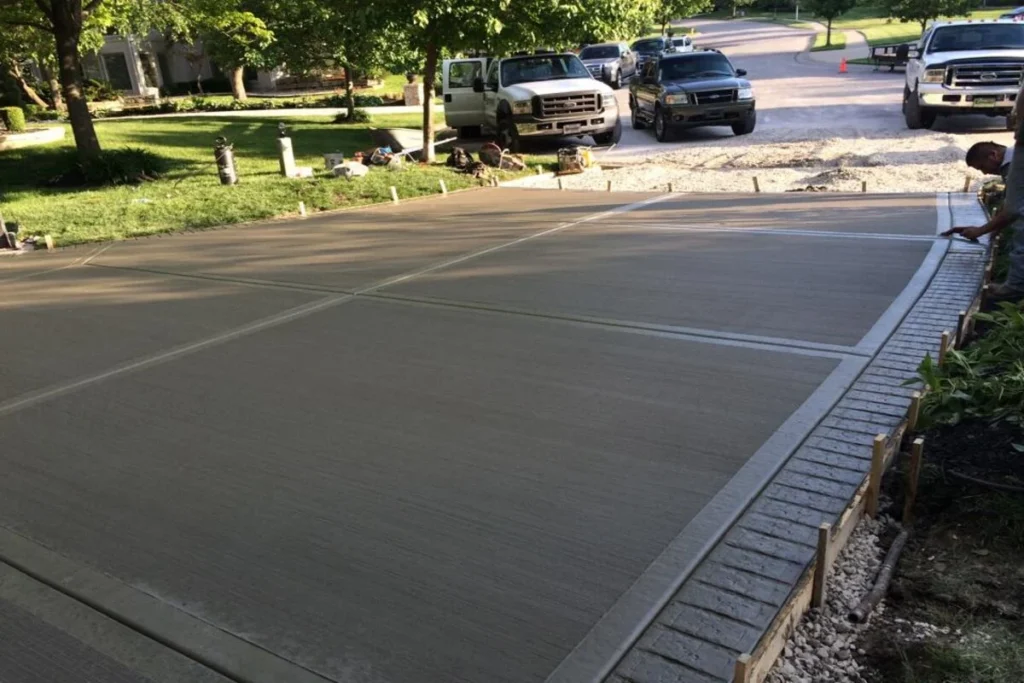
Here is the short answer, and then the part nobody tells you.
Walk on it after about 24 hours. Drive a normal car on it after about 7 days. Keep heavy vehicles — an RV, a loaded truck, a moving van, a dumpster — off it for a full 28 days.
That is the standard guidance, and on a warm July pour it works exactly like that. The part nobody tells you is that in Calgary those numbers stretch. A pour in late September or October is doing the same work in much colder air, and cold concrete gains strength slowly. The date on the calendar matters less than the temperature the concrete lived through.
Here is how to know where your driveway actually is.
The timeline, in plain terms
| What you want to do | Normal summer pour | Cool or late-season pour |
|---|---|---|
| Walk on it carefully | 24 hours | 24–48 hours |
| Ride a bike, put patio furniture on it | 3 days | 5–7 days |
| Park a regular car or SUV | 7 days | 10–14 days |
| Park a truck, RV, trailer or moving van | 28 days | 28 days minimum, longer if it was cold |
| Use de-icing salt on it | Not for one full year | Not for one full year |
If you take one thing from this article: the last row is the one that actually decides whether your driveway looks good in ten years.
Why the waiting matters
Concrete does not dry. It cures — a chemical reaction between the cement and the water that keeps going for weeks, gradually turning a soft grey slab into something that can hold a vehicle.
That reaction happens fastest in the first week and then slows down. Concrete reaches most of its strength in the first 28 days and keeps gaining slowly for years after that. Driving on it too early does not crack it dramatically in front of you. It does something quieter and worse: it puts stress into a slab that has not finished getting strong, and the damage shows up later as cracks along the wheel paths or crumbling at the edge where the driveway meets the street.
The edges are the weak point. The middle of a slab is supported all the way around. The edge is not, which is why an early delivery truck backing over the apron does more damage than a car parked in the middle.
The Calgary factor: temperature runs the clock
Concrete strength gain is driven by temperature. Warm concrete gains strength quickly. Cold concrete slows down, and near freezing it very nearly stops.
That is why the industry treats late-season pours differently here. Concrete Alberta, the provincial industry association, sets out the cold-weather rules plainly: when the air is at or below 5 °C, or likely to drop below 5 °C within 24 hours of placing, the concrete has to be kept at 10 °C for at least 7 days — or until it reaches 70% of its design strength. Concrete Alberta also cautions against placing after September 30 without proper cold-weather procedures in place.
In practice, for a homeowner, that means three things:
- If your driveway was poured in the fall, add time to every row of the table above. A week of cold, cloudy weather can push the “safe to drive” point out by several days.
- If you see blankets or a heated enclosure on your new slab, that is your contractor doing it right. Do not pull them off early to have a look.
- Ask your crew for a date, not a rule of thumb. They know what the mix was, what the weather did, and what protection went on. That answer is better than any article.
Our guide to pouring concrete in extreme heat and cold goes deeper into what changes at each end of the season.
The first winter is the one that counts
This is the single most expensive mistake Calgary homeowners make with new concrete, and it has nothing to do with driving on it.
Do not use de-icing salt on new concrete for a full year. Use clean sand for traction instead. Concrete Alberta’s guidance is direct on this: no de-icing salts in the first year after placing, and hose off any salt that vehicles track onto a new driveway. Concrete needs to reach a certain strength — or get at least 30 days of air drying — before it can handle salt and freeze-thaw cycling without damage.
What salt does to young concrete is called scaling: the top few millimetres flake off in sheets, leaving a rough, pitted grey surface with the stone showing through. It cannot be undone. It can be resurfaced, at real cost, but the original finish is gone.
Two more things to avoid in year one:
- Ammonium sulphate and ammonium nitrate should never be used as de-icers on any concrete, new or old. They attack it chemically. Check the bag — some “fertilizer-based” ice melts contain them.
- Salt tracked in from the road on your tires. Your car brings city road salt home every winter day. On a first-winter driveway, hosing it off on a mild afternoon is genuinely worth doing.
If you do need traction, the City of Calgary supplies a free sand-salt mixture from its community sand bins to help residents meet their 24-hour sidewalk clearing responsibility. Use plain sand on your own new concrete and save the mixture for the public sidewalk.
Our winter concrete maintenance guide covers de-icing, snow removal and protecting new slabs in more detail.
What to do while you wait
Days 1–7: keep it wet, keep it clear. Curing works best when the concrete stays damp. If your contractor applied a curing compound, it is handled. If not, light misting on hot days genuinely helps. Keep vehicles, trailers, ladders and stacked materials off it entirely.
Days 7–28: normal use, no heavy loads. Cars are fine on a normal summer pour. Keep the RV, the loaded work truck, the bin and the moving van off. If a delivery is coming, put plywood down over the wheel path — it spreads the load and it is cheap insurance.
After 28 days: it is a driveway. Full normal use. This is also when the sealing conversation starts.
Sealing. New concrete needs to breathe and finish drying before a sealer goes on — typically at least 28 days, and longer for a late-season pour. Sealing too early traps moisture and causes its own problems. Which product you choose matters here too; our comparison of penetrating versus film-forming sealers for the Calgary climate explains the trade-off.
“There’s a crack already” — is that normal?
Usually, yes, and usually it is not a crack.
Those straight lines cut into your driveway a day or so after the pour are control joints, and they are deliberate. Concrete shrinks slightly as it cures, and it will crack somewhere. A control joint gives it a weak line to crack along, out of sight, in a straight line, instead of wandering across the middle. When you see a hairline crack sitting inside a joint, the joint did its job.
Fine hairline cracking elsewhere on the surface in the first weeks is common and usually cosmetic. What is worth a phone call is a crack you can fit a coin into, one with a height difference across it, or one that keeps growing. Our guide to control joints and crack control explains what to expect and what not to.
FAQ
How long before you can walk on new concrete? About 24 hours for careful foot traffic on a normal pour. In cool weather, give it 24 to 48 hours. Keep pets off — paw prints set permanently.
How long before you can drive on a new concrete driveway in Calgary? About 7 days for a regular car after a warm-weather pour, and 10 to 14 days if it was poured in cool or late-season conditions. Heavy vehicles wait a full 28 days.
Can I park an RV or a loaded truck on it after a week? No. Heavy loads need the full 28 days at minimum, and longer if the concrete cured through cold weather. This is the most common way a new driveway gets damaged.
When can I use salt on my new driveway? Not for one full year. Use clean sand for traction through the first winter, and rinse off any road salt your vehicles track on.
Does rain ruin new concrete? Rain after the surface has set is largely harmless and can even help curing. Rain during finishing is a problem, and that is a call your crew makes on the day.
My driveway was poured in October. Is it going to be okay? Yes, provided it was placed and protected using cold-weather procedures — heated blankets or an enclosure, kept at temperature for at least the first week. Add time before driving on it, be strict about no salt this winter, and hold off on sealing until spring.
Not sure where your driveway is at?
Every pour is a little different, and the honest answer depends on what the weather did in the days after yours. If you had concrete poured recently and you are not sure whether it is ready for the car, the RV or the sealer, ask — we would rather answer a two-minute question than repair a slab.
We install and repair driveways across Calgary and the surrounding towns, backed by the Omega 2000 team. Have a look at our concrete driveways page, or get in touch for a straight answer about your slab.
Sources
- Concrete Alberta, Cold Weather Concrete — https://www.concretealberta.ca/construction/cold-weather-concrete
- City of Calgary, Clearing sidewalks and shovelling snow — https://www.calgary.ca/bylaws/snow-shovelling.html
- Cement Association of Canada, Expertise Centre — https://cement.ca/expertise-centre/