

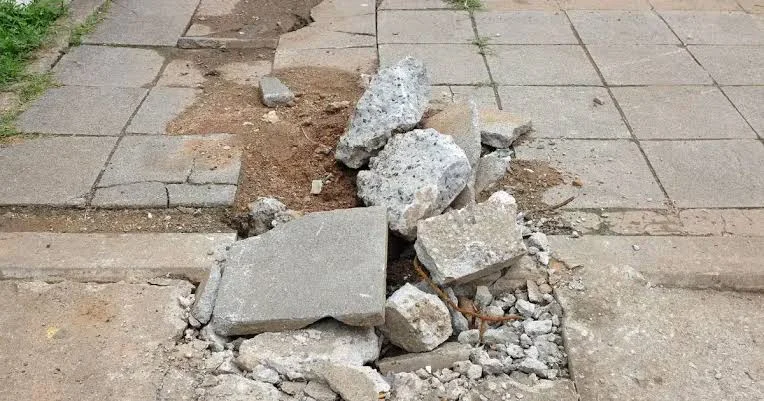
Short answer: the landlord. In Alberta, keeping a rental property safe and in good repair is the landlord’s job, and that duty does not stop at the front door — it covers the outside of the property too. A tenant only becomes responsible when the damage was caused by the tenant, their household or someone they let onto the property.
That is the rule. What trips everyone up is what happens next, because “the landlord is responsible” and “the landlord will actually do it” are two different things, and Alberta gives you more than one route depending on whether the concrete is simply ugly or genuinely unsafe.
We are a division of Omega 2000, and we get this call from both sides — a tenant who has tripped on a sunken walkway, and a landlord who has just been told the back steps are a hazard. Here is how it works in plain language.
- Normal deterioration — cracking, scaling, settling, frost movement: landlord’s responsibility.
- Damage caused by the tenant or their guests — a dropped engine block, a trailer jack punched through the slab, a fire pit burning the patio: tenant’s responsibility.
- Concrete that is actually unsafe — missing handrail, broken steps, a tripping hazard: still the landlord’s responsibility, but now there is a health authority that can order it fixed.
- Snow and ice: a separate question governed by city rules rather than by the lease, and not covered on this page.
Three questions people mix together
Almost every argument about rental concrete is really three questions being answered at once. Separating them solves most disputes before anyone needs a hearing.
- Is this a repair the landlord owes under the tenancy? That is the Residential Tenancies Act question.
- Is this condition unsafe enough that the province has a minimum standard for it? That is the Public Health Act and housing standards question.
- Did somebody break it? That is the damage question, and it is the only one where a tenant can end up paying.
They have different answers, different timelines and, importantly, different phone numbers.
What the landlord has to do
Alberta puts it simply. The landlord is responsible for keeping the rental premises reasonably safe and in good repair at all times, not just at the beginning of a tenancy. Alberta’s own guidance repeats the point in the obligations list: the landlord must ensure the rental premises are habitable at the beginning and throughout the tenancy.
“Habitable” is not a loose word. Alberta ties it to the Minimum Housing and Health Standards, made under the Public Health Act and the Housing Regulation. That is the document that converts a vague duty into something an inspector can hold up.
Two practical consequences for a Calgary rental:
- A driveway that was already cracked when the tenant moved in does not become the tenant’s problem because they lived with it. The duty runs for the whole tenancy.
- A landlord who needs to get onto the property to do the work has a route: entry for repairs is allowed on written notice, given at least 24 hours before the time of entry. A tenant cannot refuse a properly noticed repair visit, and a landlord cannot turn up unannounced with a crew.
The standard that actually covers concrete steps and porches
This is the clause most people never find, and it is the one that matters when the concrete is a safety problem rather than a cosmetic one.
Section III(3)(c)(i) of the Minimum Housing and Health Standards requires that inside or outside stairs or porches, including all treads, risers, supporting structural members, handrails, guards and balconies, shall be maintained in good repair and shall comply with the requirements of the Alberta Building Code or a Professional Engineer design.
Read that list again. Treads and risers — that is the step itself. Supporting structural members — what the step sits on. Handrails and guards — the thing a lot of older Calgary rentals quietly lost at some point. Concrete front steps with a spalled tread and no handrail are not a style complaint. They are a named item in a provincial standard.
What happens when someone complains
Complaints about housing conditions go to Environmental Public Health at Alberta Health Services. An Executive Officer can inspect and, if the property falls short, issue an Order of an Executive Officer against the owners, citing the Public Health Act, the Housing Regulation and the Minimum Housing and Health Standards.
These are real and they are public. An order issued in mid-January 2026 for a property in southeast Calgary required the owners to complete nine specific repairs within roughly two weeks. Two of those items were cited under exactly the clause above: a missing guardrail on a deck and a missing handrail on a backyard staircase. Orders carry a compliance date and an appeal route to the Public Health Appeal Board, on a short deadline printed on the order itself.
What this means in practice:
- For tenants: if the problem is a safety defect rather than an aesthetic one, you have a route that does not depend on your landlord agreeing with you.
- For landlords: an outside handrail or a broken step is a cheap fix on a Tuesday and an ordered fix with a deadline once it has been inspected. The cost does not change. The timeline does.
What the tenant has to do
The tenant’s side of the deal is shorter. Alberta lists the tenant’s obligations as keeping the rental premises reasonably clean and preventing damage to the rental premises.
“Preventing damage” is the operative phrase for concrete. A tenant is not expected to stop Calgary’s winters from working on a slab. They are expected not to break it, and not to let their visitors break it.
Damage versus normal wear and tear
Alberta draws this line most clearly in the security deposit rules: a landlord cannot deduct for normal wear and tear. Applied to exterior concrete, the split usually looks like this.
| Condition | Usually normal deterioration | Usually tenant damage |
|---|---|---|
| Hairline and shrinkage cracking | Yes | — |
| Surface flaking and scaling from freeze-thaw and de-icers | Yes | — |
| Slab settling, sunken sections, frost movement | Yes | — |
| Cracks from tree roots or ground movement | Yes | — |
| Gouges, chips and spalls from dropped heavy objects | — | Yes |
| Oil, paint or chemical staining beyond ordinary vehicle use | — | Yes |
| Cracking under a load the slab was never built for, such as a loaded trailer or heavy equipment | — | Yes |
| Fire or heat damage from a fire pit or barbecue placed on the slab | — | Yes |
Calgary’s freeze-thaw cycling is why the left column is so long. Surface deterioration on an exterior slab in this climate is expected behaviour, not neglect by the occupant — the mechanics are set out in our guides to concrete spalling repair and winter concrete maintenance.
A move-in and move-out inspection report settles most of these arguments. Photograph the driveway, the walkway and the steps on day one. It takes two minutes and it is the only evidence that pre-existing cracking was pre-existing.
What a tenant can and cannot do
Cannot: withhold rent. Alberta is explicit about this. However bad the repair situation gets, stopping rent payments puts the tenant in breach and usually ends the argument in the landlord’s favour.
Can: apply to the Residential Tenancy Dispute Resolution Service, a quasi-judicial tribunal that decides disputes under Alberta’s tenancy laws without going to court. Through the RTDRS or the courts, a tenant may seek to recover damages, have the rent reduced for the lost benefit, be compensated for the cost of performing the landlord’s obligation, or end the tenancy. Filing carries a fee that steps up with the size of the claim — a lower fee at or under $7,500 and a higher one above that, with waivers available for those who qualify.
That third option is the interesting one for concrete. “Compensated for the cost of performing the landlord’s obligation” is the mechanism a tenant would use if they paid for an urgent repair themselves — which is why the written refusal comes first and the written quote second, before anybody pours anything.
Who to call
| Situation | Where it goes |
|---|---|
| Cracked or sunken driveway, no safety issue | Landlord, in writing, with photos |
| Broken step, missing handrail, trip hazard | Landlord first; Environmental Public Health at Alberta Health Services if not addressed |
| Landlord says the tenant caused it | Move-in inspection report, photos, then RTDRS if unresolved |
| Landlord refuses a repair the tenancy requires | RTDRS application |
| Tenant stopped paying rent over it | Resolve the rent issue first — withholding is not permitted |
If the rental is a condo or townhouse
A rented condominium unit has two layers running at once: the tenancy between landlord and tenant, and the ownership rules of the condominium corporation. The tenancy answer on this page still applies between landlord and tenant. Whether the corporation or the individual owner ultimately pays is a different statute with a different answer, and we have covered it separately.
Where this page stops
This page covers who is responsible for exterior concrete at a rented home in Calgary. It does not cover snow and ice clearing duties, which come from city rules rather than the lease. It does not cover permits for new concrete work, home insurance coverage for concrete damage, new home warranty on a newly built house, or who pays inside a condominium corporation — each of those is its own question and we have written about them separately. It does not diagnose why a slab is cracking; for that, start with concrete foundation cracks and when to worry. And it is general information, not legal advice — for a specific dispute, speak to a lawyer or to the RTDRS.
FAQ
Is a landlord in Alberta required to repair a cracked driveway? Generally yes. The landlord must keep the rental premises reasonably safe and in good repair throughout the tenancy, and that duty covers the exterior. Ordinary cracking, scaling and settling are the landlord’s to deal with. A tenant becomes liable only for damage they or their guests caused.
Can my landlord charge me for driveway cracks when I move out? Not for normal wear and tear — Alberta does not allow security deposit deductions for that, and freeze-thaw surface damage on a Calgary slab is normal wear. A deduction for a gouge from a dropped object or for cracking under equipment the slab was not built for is a different matter. Your move-in inspection report is the deciding evidence.
What if the concrete steps at my rental are unsafe? That moves from a tenancy question to a housing standards question. Section III(3)(c)(i) of the Minimum Housing and Health Standards requires outside stairs and porches, including treads, risers, supporting members, handrails and guards, to be maintained in good repair. Raise it with the landlord in writing, and if it is not addressed, contact Environmental Public Health at Alberta Health Services, which can inspect and issue an order to the owners.
Can I withhold rent until the repair is done? No. Alberta is clear that a tenant cannot withhold rent. Apply to the RTDRS instead, where you can seek a rent reduction, damages, compensation for performing the landlord’s obligation, or an end to the tenancy.
How much notice does my landlord need to come and do the work? Written notice at least 24 hours before the time of entry. With that notice, the landlord may enter to do repairs without further permission.
Can I pay for the repair myself and bill my landlord? It is possible but it is not automatic. The RTDRS can award compensation for the cost of performing the landlord’s obligation. Get the request and the refusal in writing, get a written quote, and keep every receipt — reimbursement depends on being able to show all three.
Who repairs concrete if the rental is a condo unit? The landlord still owes the tenancy duty. Whether the landlord or the condominium corporation ultimately pays for that concrete depends on the condominium’s own documents, which is a separate question from the tenancy.
Need a repair quote a landlord and tenant can both read?
If you are a Calgary landlord with a driveway, walkway or set of steps that needs fixing — or a tenant who needs a written quote to take to an owner — we will look at it and give you a plain, itemised price with no pressure attached. Start with concrete repair in Calgary, or send us a few photos and the address and we will tell you what we are seeing.
Sources
- Government of Alberta, During a tenancy — https://www.alberta.ca/during-a-tenancy
- Government of Alberta, Landlords and tenants: rights and responsibilities — https://www.alberta.ca/rights-and-responsibilities
- Government of Alberta, Residential Tenancy Dispute Resolution Service — https://www.alberta.ca/residential-tenancy-dispute-resolution-service
- Alberta Health Services, Environmental Public Health, Order of an Executive Officer, southeast Calgary property, January 2026 — https://www.albertahealthservices.ca/assets/wf/eph/wf-eph-cgy-55-auburn-glen-view-se-calgary-january-15-2026-a.pdf