

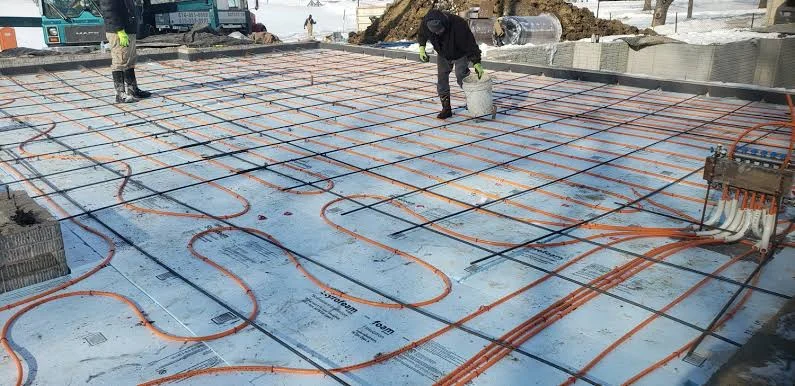
Here’s the short answer. Electric in-floor heating in a concrete slab runs roughly $8 to $17 per square foot installed. Hydronic — that’s the kind with warm water in tubing, run off a boiler — runs roughly $15 to $35 per square foot, plus $3,000 to $10,000 or more for the boiler and the mechanical room it lives in.
The part almost nobody tells you is the second number: what it costs to keep it on all winter. That depends entirely on Calgary power and gas rates, and most of the price guides you’ll find online are running American numbers. So let’s do it with ours.
One thing first, because it saves people a lot of money: the cheapest time to put heat in a concrete floor is before the concrete is poured. Everything else in this article is easier if you’re reading it early.
The two kinds, in plain English
There are two systems, and they suit different jobs.
Electric. Thin heating mats or cable get laid on top of the insulation and rebar, then the concrete gets poured over them. There’s no boiler, no pump, no plumbing — just a thermostat and a circuit. Simpler to install, cheaper up front, more expensive to run.
Hydronic. Flexible tubing gets tied down in the same place, then warm water is circulated through it from a boiler. More parts, more money up front, much cheaper per hour of heat — which is why it’s the choice when you’re heating a big area or heating it constantly.
The rough rule: electric for small areas, hydronic for whole floors. A basement bathroom is electric. A 1,200 square foot basement you intend to live in is hydronic. A double garage sits right in the middle, and the answer usually depends on how often you actually want it warm.
What it costs to install
| System | Installed cost | Extra equipment |
|---|---|---|
| Electric mat or cable | About $8–$17 per sq ft | Thermostat; usually a dedicated circuit |
| Hydronic tubing | About $15–$35 per sq ft | Boiler, pump, manifold: $3,000–$10,000+ |
For a typical Calgary double garage of about 440 square feet, that’s roughly $3,500 to $7,500 for electric, or $6,600 to $15,400 for the hydronic tubing before you add the boiler.
Two things move those numbers on a real job:
- New pour or retrofit. Putting tubing or cable into a slab you’re pouring anyway is mostly labour. Adding heat to an existing slab means either a topping over the old floor or breaking it out, and that changes the price bracket completely.
- How the floor gets finished. A polished or sealed slab as the final floor costs less than a slab plus tile plus underlay.
What it actually costs to run in Calgary
This is where local numbers matter, and the good news is they’re public.
The default electricity rate for Calgary homes on ENMAX’s service area is 12.06 cents per kilowatt-hour, and default natural gas through Direct Energy Regulated Services has moved between about $1.78 and $3.33 per gigajoule so far in 2026. Both are published by the Utilities Consumer Advocate. Those figures are the energy itself — your bill also carries delivery and admin charges — but they’re the right basis for comparing systems.
Electric floor heating mats typically draw about 12 watts per square foot. Run that through Calgary’s rate:
| Area | Power draw | Cost if it ran flat out | Realistic monthly cost |
|---|---|---|---|
| 60 sq ft basement bathroom | 0.72 kW | About $0.35 for 4 hours | Roughly $4–$10 a month |
| 400 sq ft finished basement | 4.8 kW | About $3.47 for 6 hours | Roughly $40–$105 a month |
| 440 sq ft double garage | 5.28 kW | About $5.09 for 8 hours | Roughly $60–$155 a month |
That last column has a range because a floor doesn’t draw power the whole time it’s on. Once the slab is up to temperature the thermostat cycles it — a well-insulated floor might call for heat 40% of the time, a poorly insulated one much more. The low end of each range assumes a floor that holds its heat. The high end assumes one that doesn’t.
Look at the bathroom row and the basement row together and the whole electric-versus-hydronic question answers itself. Ten dollars a month for a warm bathroom floor is a nice thing to buy. A hundred dollars a month to warm a basement all winter is a heating bill, and at that point the gas-fired system starts paying for its own installation.
The insulation underneath decides your bill
If you take one technical thing away, make it this: a heated slab needs insulation under it, and skipping it is the single most expensive mistake in the whole project.
Concrete conducts heat in every direction, including straight down into Calgary’s cold ground. Without a layer of rigid foam beneath the slab, a meaningful share of what you pay for heads into the dirt and never reaches your feet. Alberta’s building code recognizes this and requires insulation under a heated floor — around R-16 in our climate zone, which is a couple of inches of rigid foam depending on the product.
That insulation is cheap while the ground is open and impossible to add afterward. It’s the reason a heated floor decision belongs in the planning stage, not the finishing stage.
Where heated floors make sense in a Calgary home
Direct answer: they make the most sense where the floor is cold, hard, and you stand on it.
- Basements. Concrete on soil is always the coldest surface in the house. A heated basement slab changes how the whole level feels, and it’s the most common request we get.
- Garages and shops. A heated garage floor melts the snow that comes off your vehicle, so the floor dries instead of holding slush. That matters here for a reason beyond comfort: the salt and de-icer tracked in from Calgary roads is what causes surface flaking, and a floor that dries out sheds it. If your existing garage floor is already flaking, our spalling repair guide for homeowners walks through what can be saved.
- Bathrooms and entryways. Small areas, small cost, high daily payoff. This is where electric wins outright.
- Driveways and walkways. Possible, and lovely in February, but the running cost is a different conversation because you’re heating outdoors. Worth pricing carefully rather than assuming.
Where it makes less sense: a garage you only use for storage, or a slab you’re not planning to finish or spend time on.
When you have to decide
The order of work is fixed, and it’s short:
- Excavate and prepare the base.
- Lay the under-slab insulation.
- Lay the rebar, then tie down the heating cable or tubing.
- Pressure-test the tubing (hydronic) or check the cable resistance (electric) before anything gets covered.
- Pour and finish the concrete.
- Connect the thermostat, or the boiler and manifold.
Step 4 is the one to insist on. Once concrete is over the top, a damaged loop is a very bad day for everyone. Any crew that skips a test before the pour is taking a risk with your money.
Control joints — the tooled or saw-cut lines that tell a slab where to crack — also need to be planned around the heating layout so a saw blade never meets a cable. We cover how those are laid out in our guide to control joints for residential flatwork.
Permits, briefly
You’ll need an electrical permit for the wiring on an electric system. In Calgary, a homeowner permit is $116.50 and is available if you own the home, live in it, and do the work yourself. Homeowners cannot pull a gas permit, so the boiler side of a hydronic system has to go through a licensed gas fitter. Both electrical and plumbing rough-ins get inspected before things are closed up, which lines up neatly with testing the loops before the pour.
What about an existing slab?
You have three realistic options, and honesty is cheaper than optimism here:
- A heated topping. A thin overlay containing electric cable, poured over the existing floor. Raises the floor height by an inch or two, which matters at door thresholds and garage overhead doors.
- Remove and repour. More disruptive and more expensive, but you get proper under-slab insulation, which the topping option can’t give you.
- Heat the room instead. For a garage especially, a unit heater often delivers the same comfort for far less money. We’d rather tell you that than sell you a floor you don’t need.
FAQ
How much does a heated garage floor cost in Calgary? Roughly $3,500 to $7,500 installed for electric heating in a typical 440 square foot double garage, or $6,600 to $15,400 for hydronic tubing before the boiler. Running it costs somewhere around $60 to $155 a month in winter on current Calgary electricity rates, depending on insulation and how often you run it.
Is in-floor heating cheaper to run than a furnace? For a small area, an electric floor is inexpensive but not a heating system. For a whole floor, a hydronic system running on natural gas is usually cheaper per hour of heat than electric, which is why bigger areas go hydronic.
Can you add heating to a concrete floor that’s already poured? Yes, with a heated topping poured over the existing slab, or by removing and repouring. A topping raises the floor height and can’t add the insulation underneath, which is the part that controls your running cost.
How long does a heated floor take to warm up? Concrete is slow on purpose. A slab takes hours to come up to temperature and holds it for hours after the thermostat stops calling. Set it and leave it rather than switching it on and off.
Does a heated slab crack more? Not because it’s heated. Cracking is controlled by proper thickness, base preparation and control joint layout, the same as any slab. Keep the joint layout coordinated with the heating loops and you’re in the same position as an unheated floor.
Thinking about it for next season?
If a basement, garage or addition is on your list, this is the decision to make early — the insulation and tubing cost far less to install than to add later. Tell us the square footage and how you plan to use the space, and we’ll give you a straight number for both options, including what it will cost you in January.
Have a look at in-floor heating in Calgary, and if you want to protect what you already have through this winter, our winter concrete maintenance guide is the place to start. As always, the work is backed by the Omega 2000 team.
Sources
- Utilities Consumer Advocate, Government of Alberta — Default rates: https://ucahelps.alberta.ca/residential/rates/default-rates/
- City of Calgary — Homeowner electrical and plumbing permits: https://www.calgary.ca/development/home-building/trades-permits.html
- WarmlyYours — Radiant floor heating cost guide: https://www.warmlyyours.com/en-CA/posts/How-Much-Does-Floor-Heating-Cost-2574