

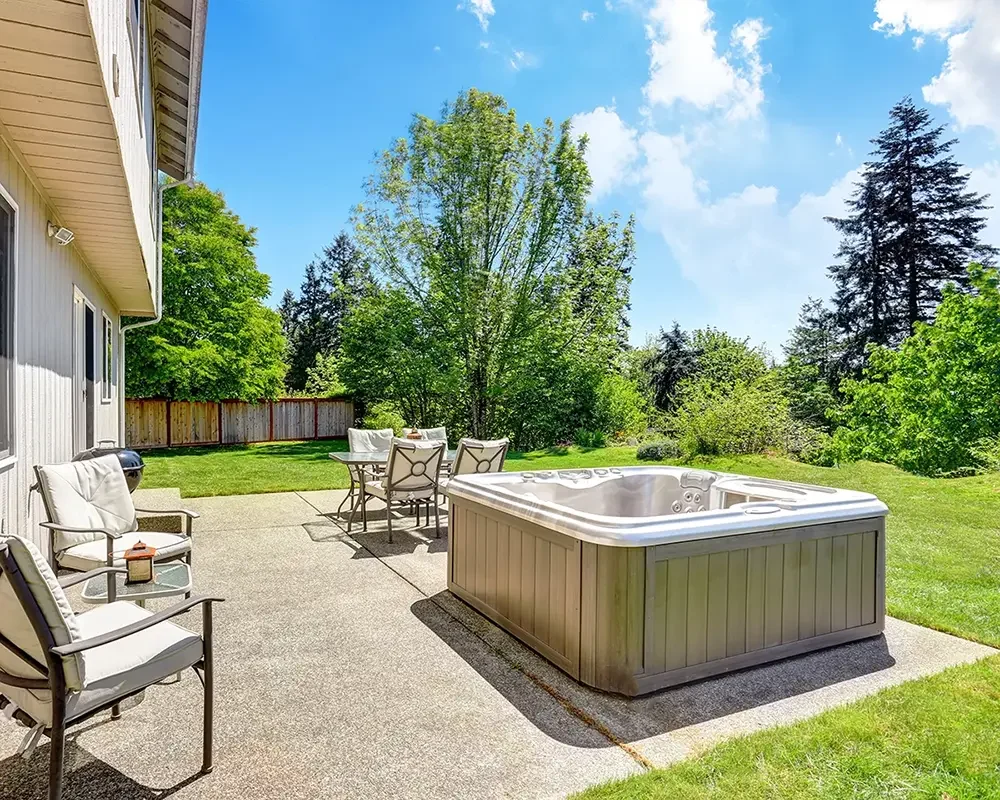
A hot tub is heavier than almost anything else you will ever put in your backyard, and most people find that out about a week before it arrives. The good news is that the requirements are not complicated.
In Calgary you need a building permit if the tub can hold water deeper than 0.6 m (2 feet), it has to sit at least 1.2 m back from your side and rear property lines, and a permanently installed tub has to be wired by a qualified electrical contractor. The pad itself is a straightforward pour — as long as it is sized and built for the load before the delivery truck shows up.
Here is everything worth knowing, in the order you will actually need it.
First, the weight — because it explains everything else
Water weighs one kilogram per litre. That sounds obvious until you apply it to a hot tub.
A tub holding 1,500 litres is carrying 1,500 kg of water alone — about 3,300 pounds — before you add the shell, the cabinet, the equipment, or four adults sitting in it. Your tub’s spec sheet will list a “filled weight” or “operating weight,” and that is the number your pad has to carry. Find it before anyone talks about concrete.
That weight is also why the City cares about what is underneath. If a hot tub sits on a structure that raises it above grade — a deck or a raised patio — the City of Calgary requires an engineer’s stamp for the loading, regardless of how high the structure is. No exceptions for “it’s only a step up.” That single rule is the reason most Calgary homeowners end up putting the tub on a concrete pad at ground level instead: a pad on properly prepared ground does not need an engineer, and a deck does.
Do you need a permit for a hot tub in Calgary?
Usually, yes. Here are the thresholds in plain terms.
| Requirement | The rule |
|---|---|
| Building permit | Required if the hot tub can contain water deeper than 0.6 m (2 feet). Most standard hot tubs exceed this. |
| Maximum water depth | Under Alberta Building Code standards, water depth should not exceed 1.2 m measured from the hot tub floor to the water surface. |
| Setbacks | At least 1.2 m from side and rear property lines. A hot tub may not go in the front setback without a development permit. |
| Overhead wiring clearance | Any existing overhead wiring must be clear of the tub by 5.0 m vertically and 5.0 m horizontally. |
| Fence or cover | A fence is not required if the tub has a cover designed and built to ASTM F 1346 with lockable devices preventing access by unauthorized people. |
| Electrical | All permanently installed hot tubs must be wired by a qualified electrical contractor. |
Two of those catch people out most often.
The overhead wiring one. Five metres in both directions is a large envelope. If your service drop crosses the backyard, measure before you pick a spot — moving a pad after it is poured is a much worse day than moving a chalk line.
The cover option. You do not automatically need to fence your yard. A compliant, lockable cover built to ASTM F 1346 satisfies the safety requirement on its own. Check that the cover your dealer is quoting actually states that standard.
What the permit application asks for
The City’s hot tub permit requirement list expects a dimensioned site plan — metric 1:200, or 1″ = 20′-0″ in imperial — showing property lines, streets, setbacks, your house foundation, yard dimensions, and the location, size and shape of the proposed hot tub with dimensions out to the property lines. If your condo board has a say, you will need a letter of authorization from them too.
If the tub is going on a raised structure, add a full plan set, deck construction details, fence and gate locations, equipment locations, and that engineering stamp for the loading.
What it costs at the City
Calgary’s 2026 fee schedule puts a hot tub in the same category as carports, decks, retaining walls and fireplaces:
- Building permit: $112 processing + $86 base + $7.92 Safety Codes Council fee = $205.92
- Homeowner electrical permit: $112 + $4.50 Safety Codes Council fee = $116.50
The electrical permit line is worth reading carefully, though — see below, because it may not be yours to pull.
The electrical piece — the part homeowners cannot do themselves
Calgary allows homeowners to pull their own electrical permits for a lot of work in their own home. Hot tubs are one of the places where that stops. Homeowners are not permitted to install electrical wiring in permanent, in-ground swimming pools and hot tubs, and the City states plainly that permanently installed hot tubs must be wired by a qualified electrical contractor.
Two more details from the City’s homeowner guide that affect where your pad goes:
- Hot tubs and hydro-massage tubs must have Class A ground fault protection — this is the safety device that cuts power the instant current leaks where it shouldn’t.
- A GFCI receptacle cannot be closer than 3 m to a hot tub. So if you want a plug near the tub for a phone charger or a light, it has to live at least three metres away.
One more thing worth knowing: electrical contractors cannot work under a homeowner permit. They pull their own. So the $116.50 homeowner electrical fee above is for other projects — for your tub, the electrician’s permit is part of their quote.
Sizing and building the pad itself
This is the part we do, and it is the least dramatic part of the project.
Make the pad bigger than the tub. A pad that matches the tub footprint exactly leaves you nowhere to stand, nowhere to set a step, and an edge that catches every freeze-thaw cycle. Adding a comfortable margin on all sides — and more on the side where the equipment access panel opens — is the difference between a tub you can service and one you cannot.
Thickness follows the filled weight. Around Calgary, a pad for a standard family-sized tub is typically poured in the 100–150 mm range (4 to 6 inches), thicker for swim spas and large-capacity tubs. The right number for your tub comes from its operating weight, not from a rule of thumb, which is why we ask for the spec sheet before quoting.
The base matters as much as the concrete. A compacted granular base — crushed gravel, properly levelled and compacted in lifts — is what keeps a floating slab from tipping in Calgary’s clay soils. Skipping base prep is the single most common reason a backyard pad ends up out of level two winters later.
Slope it, slightly. A pad should shed water away from the house and away from the tub cabinet. A very gentle fall is enough — you are moving rainwater and snowmelt, not draining a pool.
Plan the joints. Any slab that size needs its cracking controlled rather than left to chance. That is what control joints do, and getting them right is worth a read on its own in our definitive guide to control joints for residential flatwork.
Think about the path in. Hot tubs are usually walked in on a dolly or craned over the house. Both need clearance, and the crane option needs to be booked. Confirm the delivery route before the pad location is final, not after.
When to pour it in Calgary
Concrete needs time and temperature, and both are in short supply here for part of the year. If your tub is arriving in spring, pour the pad in the fall or as early in the season as your contractor’s schedule allows. If it is arriving in the fall, do not squeeze the pour into the last warm week — that is exactly the situation where a slab gets placed into weather it cannot handle, which we cover in pouring concrete in hot and cold weather.
As a general rule, give a new pad time before you fill and load it. Concrete keeps gaining strength for weeks after it looks finished, and a hot tub is a permanent, heavy, uneven load. Your contractor will tell you the wait for your specific pour and season — in Calgary that answer is different in June than it is in October.
Keeping it in good shape
Once the tub is in, the pad around it lives a hard life: splash-out, chemical drips, snow shovelling, and a cover that dumps meltwater in the same spot every thaw.
- Sealing slows down freeze-thaw damage on the exposed concrete around the tub. Our concrete sealing service page explains the options.
- Skip the salt. De-icing salt on a young slab is the fastest way to make a good pad look bad. Our guide to winter maintenance and protecting new slabs walks through what to use instead.
- Rinse chemical spills. Spa chemicals are harder on concrete than pool water. A quick hose-off after topping up the tub is enough.
Frequently asked questions
Do I need a permit for a hot tub in Calgary? You need a building permit if the tub can contain water deeper than 0.6 m (2 feet), which covers most standard hot tubs. The 2026 fee is $205.92 in total. A permanently installed tub also requires wiring by a qualified electrical contractor, who pulls their own electrical permit.
How far from the fence does a hot tub have to be? At least 1.2 m from side and rear property lines. It cannot go in the front setback without a development permit.
How thick should a hot tub pad be? It depends on the tub’s filled weight. Around Calgary a standard family tub typically sits on a pad in the 100–150 mm (4–6 inch) range, with more for swim spas. Get the operating weight from the spec sheet and let that set the number.
Can I put my hot tub on my existing deck? Only with an engineer’s stamp. The City of Calgary requires engineering for the loading whenever a hot tub is supported by a structure that raises it above grade — a deck or raised patio — no matter how low that structure is.
Do I have to fence my yard for a hot tub? Not necessarily. A fence is not required if the tub has a cover designed and constructed to ASTM F 1346 with lockable devices that prevent unauthorized access to the water.
Can I wire the hot tub myself to save money? No. Calgary does not permit homeowners to install electrical wiring for permanent hot tubs. It must be done by a qualified electrical contractor, and hot tubs require Class A ground fault protection.
Get the pad settled before the tub is booked
The order that works: get the tub’s filled weight and footprint, confirm setbacks and overhead clearances, sort the permit, then pour the pad with enough lead time that it is ready when the tub arrives. That order costs nothing extra. Backwards is how people end up storing a hot tub in the driveway for a month.
We build backyard pads across Calgary and the surrounding towns, backed by the Omega 2000 team, and we are happy to walk your yard before anything is committed. Send us the tub’s spec sheet and a photo of the space, and we will tell you what will fit, where it can go, and what the pad needs to be — see our concrete pads page or get in touch for a free quote.
Sources
- City of Calgary — Hot tubs, pools and ponds
- City of Calgary — Hot Tub Building Permit Requirement List (CARL)
- City of Calgary — 2026 Building and Trade Permit Fee Schedule
- City of Calgary — Homeowner electrical wiring guide