


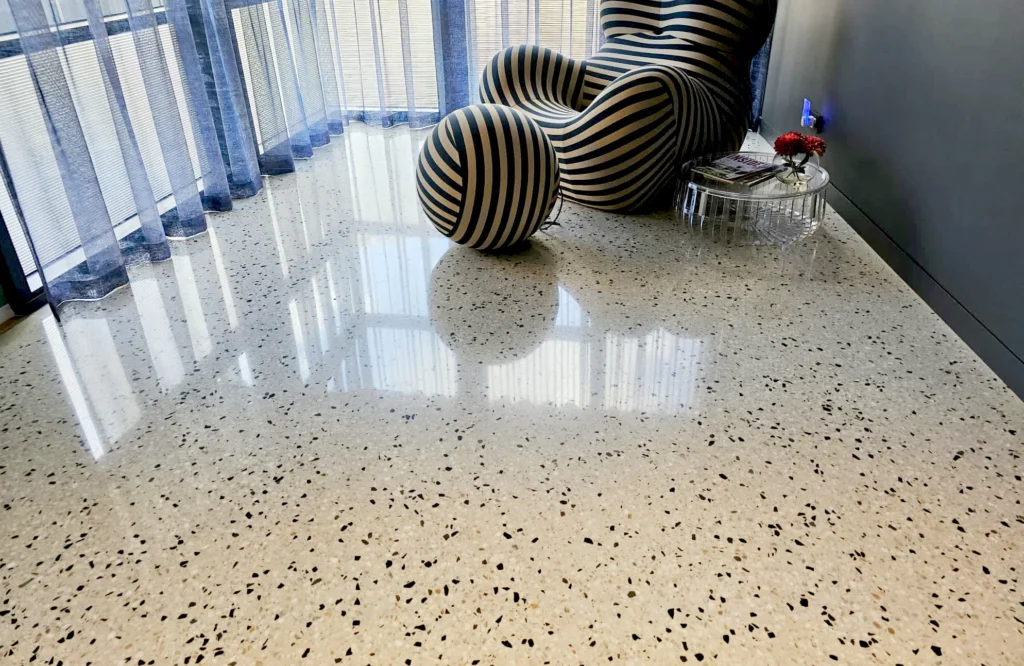
Most polished concrete floors in Canada land between $3 and $13 per square foot. For a typical Calgary basement of about 800 square feet, that works out to roughly $2,400 to $10,400 — a wide range, and the reason it’s wide is the whole point of this article.
The price isn’t really about the size of the room. It’s about how much grinding your slab needs before it looks like anything, how shiny you want it, and whether the concrete under your carpet turns out to be in good shape or not. Here’s how to figure out where your floor sits in that range before anyone comes to quote it.
What “polished concrete” actually means
Polishing is grinding, not coating. A crew runs a heavy machine fitted with diamond discs across your slab, starting coarse and working progressively finer — the same idea as sanding a piece of furniture from rough paper to fine. Partway through, a liquid called a densifier is applied. It soaks in and chemically hardens the surface so the finer discs can bring up a shine that lasts.
That’s different from grind-and-seal, which is what a lot of “polished concrete” quotes actually describe. Grind-and-seal means the crew grinds the surface flat, then rolls on a clear topcoat to create the gloss. It’s cheaper and faster. It also wears the way any coating wears: it scuffs, it can peel at the edges, and eventually it needs stripping and redoing. True mechanical polishing has no coating to fail — the shine is in the concrete itself.
Neither one is wrong. Grind-and-seal makes sense in a garage or a workshop where you want something tough and inexpensive. Mechanical polishing makes sense in a living space you plan to keep for twenty years. Just make sure you know which one you’re being quoted, because the price difference is real and so is the difference in how it ages.
The two decisions that set your price
Everything else is detail. These two choices move the number more than anything else.
1. How much aggregate you want to see
Aggregate is the stone and sand mixed into the concrete. The deeper the crew grinds, the more of it shows — and the more grinding, the more the job costs. The industry sorts this into classes:
| Class | Common name | Roughly how deep | What you see |
|---|---|---|---|
| A | Cream | Barely a skim | Almost no stone. Smooth, uniform, closest to plain concrete |
| B | Salt and pepper | About 1/16 in. | Flecks of fine sand throughout — the most popular look |
| C | Medium aggregate | About 1/8 in. | Medium stones showing, more like a terrazzo |
| D | Large aggregate | About 1/4 in. | Big stones fully exposed. Dramatic, and the most work |
There’s a catch with cream finishes that catches Calgary homeowners out. Because a Class A grind barely cuts the surface, it leaves whatever was already there — old adhesive marks, trowel lines, the outline of where a wall used to be. If your slab has a history, the cheap-sounding shallow grind may be the wrong choice, and going one class deeper is what actually makes it look finished.
Published cost guides put cream finishes at roughly $3 to $8 per square foot, salt and pepper at $4 to $10, and full aggregate exposure at $6 to $12.
2. How shiny you want it
Gloss is set by how fine the diamond discs go at the end. Four levels are standard:
| Level | Finish | Grit used | How it reads in a room |
|---|---|---|---|
| 1 | Flat | Under 100 | Matte. No reflection to speak of |
| 2 | Satin | 100–400 | Soft low sheen; you’d see overhead lights from across a big room |
| 3 | Semi-polished | 800+ | Clear reflection of lights from 30 to 50 feet, objects blurry |
| 4 | Highly polished | 3,000 | Mirror-like. Your reflection is sharp; the floor can look wet |
Cost tracks with gloss the same way: about $3 to $6 per square foot for a soft matte, $4 to $8 for low sheen, $5 to $10 for medium gloss, and $6 to $15 for high gloss.
For a Calgary basement, level 2 or 3 is usually the sweet spot. Level 4 is stunning in a showroom with good lighting; in a basement with two small windows it shows every footprint and takes more upkeep than most families want.
What drives your quote up
The condition of your existing slab matters more than the square footage. These are the extras that show up on real quotes:
- Removing old flooring or glue. Carpet tack strips, vinyl adhesive, old tile mortar — all of it has to come off before grinding starts, and stubborn adhesive can add a full day.
- Crack and joint repair. Filling cracks and control joints before polishing typically runs a few hundred dollars for a residential floor. If you’re not sure whether your cracks are cosmetic or something else, our guide to foundation cracks and when to worry is the place to start.
- Levelling. If the slab has dips or a slope, self-levelling material adds real cost per square foot — sometimes as much as the polishing itself.
- Surface damage. Pitting, scaling or flaking on a garage slab has to be dealt with first. Our spalling repair guide covers what that involves.
- Colour. Dye adds roughly $1 to $3 per square foot. Acid staining in a single colour is more, and intricate multi-colour work more again.
And two Calgary-specific ones worth flagging:
- In-floor heating. If your slab has heating tubes in it, tell the contractor before they quote. Polishing is generally fine over in-floor heat, but the crew needs to know how deep they can safely cut, and aggressive aggregate exposure may be off the table.
- Older inner-city basements. Slabs in Calgary homes from the 1950s and 60s are often thin, unreinforced and poured over questionable base. They can polish beautifully — but they need looking at first, not just measuring.
Roughly what it costs by room
Here’s how the per-square-foot ranges shake out on real Calgary spaces. These assume a slab in reasonable condition with no major levelling:
| Space | Typical size | Ballpark range |
|---|---|---|
| Small basement room or office | 200 sq ft | $1,600 – $3,000 |
| Double garage | 400–500 sq ft | $4,000 – $7,500 |
| Developed basement | 800–1,000 sq ft | $7,000 – $12,000 |
| Main floor of a bungalow | 1,200–1,500 sq ft | $8,000 – $15,000 |
These ranges come from published North American cost guides and line up with the $3-to-$13-per-square-foot Canadian pricing above. Treat them as a starting point for budgeting, not a quote.
Two notes on reading that table. Small jobs cost more per square foot than large ones, because mobilizing the equipment costs the same either way — a 200 sq ft room won’t be priced at the same rate as a 2,000 sq ft floor. And a garage often costs more than its size suggests, because garage slabs have usually seen salt, oil and freeze-thaw damage that has to be repaired before polishing.
How long you’ll be out of the room
Most residential polishing jobs up to about 2,000 square feet take two to four days. That’s grinding, densifier, polishing passes and final cleanup. Bigger commercial spaces of 5,000 to 10,000 square feet run one to two weeks.
Add time if there’s flooring to remove, cracks to fill, or levelling to cure. Levelling compound in particular needs its own drying time before anyone grinds it.
The good news is that polishing is a dry-ish, dust-controlled process. Modern grinders run with vacuum extraction, so it isn’t the disaster people imagine. You’ll still want to seal off the work area and plan to be somewhere else during the grinding days.
One important timing rule for new concrete: if your slab was just poured, it needs about 28 days to cure before it can be polished. Grinding it early can leave a soft, uneven surface that won’t take a shine.
Living with a polished floor in Calgary
Polished concrete holds up well here, with a few local realities worth knowing:
- It’s hard and it’s cold. Concrete doesn’t hold heat on its own. In a Calgary basement, area rugs, warm socks, or in-floor heating are how people make it comfortable.
- Winter grit is the enemy of shine. Sand and ice-melt tracked in from the driveway is abrasive. A walk-off mat at the door and regular dust-mopping does most of the work of keeping the gloss.
- Cleaning is simple. Dust mop regularly, damp mop with a pH-neutral cleaner. Don’t use vinegar or acidic cleaners — they etch the surface. No waxing needed.
- Control joints stay visible. The saw-cut lines in your slab don’t disappear when it’s polished; they get filled and blend in, but you’ll still see them. That’s normal — here’s why those joints are there.
- Small cracks may develop. Concrete moves. Polished concrete can develop hairline cracks over the years the same as any slab. Most homeowners find they read as character; if they bother you, they can be filled.
FAQ
Is polished concrete cheaper than tile or hardwood? Usually, yes — especially when the slab is already there and in good shape. You’re finishing an existing surface rather than buying and installing a new one on top of it. The savings shrink if your slab needs a lot of repair or levelling first.
Can any concrete floor be polished? Most can, but not all. Slabs that are badly cracked, heavily contaminated with oil, crumbling at the surface, or very soft may not take a polish well. A contractor should test-grind a small area before committing you to a price.
Will polishing fix an uneven floor? Only slightly. Grinding takes off high spots but it will not fill low ones. If your floor has noticeable dips, you’re looking at self-levelling material first, which is a separate line on the quote.
How long does a polished concrete floor last? Decades, in a residential setting. Because the shine is ground into the concrete rather than sitting on top of it, there’s no coating to peel or wear through. It may need re-burnishing eventually to restore gloss in high-traffic paths.
Does polished concrete work in a basement with moisture? It handles moisture better than most flooring, because there’s no coating to trap water underneath and no wood or backing to rot. But a slab with an active moisture problem needs that problem diagnosed first, whatever you plan to put on it.
Get a real number for your floor
The honest answer to “what will my floor cost” is that somebody has to look at your slab. Pull back a corner of the carpet, take a photo, and send it over — most of the time we can tell you from that alone whether you’re at the low end of the range or the high end, and why.
We’re a division of Omega 2000, and we’ve been finishing concrete floors across Calgary, Airdrie, Cochrane, Okotoks and Chestermere for years. We’ll tell you straight if your slab isn’t a good candidate.
Get a quote on concrete polishing →
Sources
- American Society of Concrete Contractors, Concrete Polishing Council — Aggregate Exposure Chart — https://ascconline.org/Portals/ASCC/CPC_Aggregate_Exposure_Chart_10-25-2017.pdf
- Concrete Network — Levels of Concrete Polishing — https://www.concretenetwork.com/concrete/polishing/levels.html
- HomeGuide — How Much Do Polished Concrete Floors Cost? — https://homeguide.com/costs/polished-concrete-floor-cost