

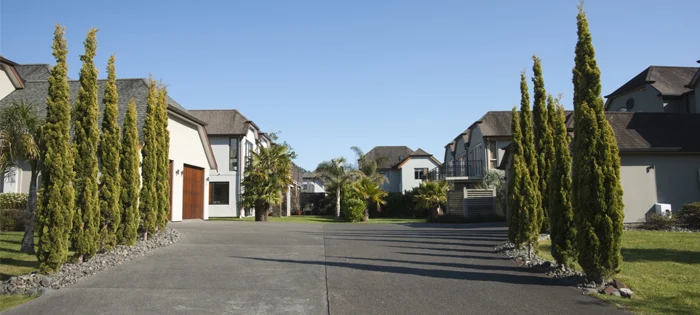
If you live in Killarney, Renfrew, Bowness or any of Calgary’s older inner-city streets, there’s a good chance your driveway touches your neighbour’s — or is the same slab as your neighbour’s, poured once decades ago by a builder who never wrote down who owned what. It works fine for years. Then the slab cracks, or one of you sells, or someone wants to widen, and suddenly a strip of concrete needs an owner.
Here’s the thing most homeowners get wrong: the answer is almost never “we split it.” The answer is on your title and on a survey document, and until someone reads those two things, every conversation about the driveway is a guess.
Start with the only two documents that matter
Before you get quotes, before you talk to your neighbour, get these.
Your Real Property Report (RPR). This is a survey drawing made by an Alberta Land Surveyor showing exactly where your property lines run and where every structure sits relative to them — house, garage, fence, retaining wall, driveway. The City notes that an RPR “may be obtained from any Alberta Land Surveyor.” It is the document that tells you whether your driveway is on your land, on your neighbour’s, or crossing the line.
Your certificate of title. This lists everything registered against your property, including any easement — a registered right for someone to use part of your land, or for you to use part of theirs. If a previous owner and a previous neighbour did this properly, the arrangement is sitting on your title right now and it is binding.
Most of the uncertainty people feel about shared driveways evaporates the moment they see the line drawn on a survey.
The four situations, and what each one means for you
Almost every Calgary shared driveway falls into one of these. Which one you’re in decides everything that follows.
| Situation | What it means | Who can authorize work |
|---|---|---|
| One slab, entirely on your land, neighbour just drives over it | It’s your driveway. Their use is a courtesy unless registered | You, alone |
| One slab crossing the line, with a registered mutual easement | A formal joint arrangement that binds both of you and future owners | Both parties, per the agreement |
| One slab crossing the line, nothing registered | An encroachment. Legally unresolved | Nobody, cleanly — see below |
| Two separate driveways that simply meet at the line | Two separate driveways | Each owner, on their own side |
That third row is where the trouble lives, and it is the most common situation in older Calgary neighbourhoods.
What a registered mutual easement actually does
If your arrangement was done properly, it was registered as an easement, and Alberta’s land titles practice is specific about what that means.
An easement “confers on the owner of a parcel of land ‘the right to use the land of another in some way, or to prevent it from being used for certain purposes.'” It needs two parcels — in the language of the registry, a dominant tenement (the land that benefits) and a servient tenement (the land that carries the burden). It cannot exist without both, and there “must be a certificate of title issued for all affected parcels of land.”
Two features matter enormously for a driveway. First, it “runs with the land” and must be “enforceable by and against successors in title to land.” That means it survives a sale: the person who buys your neighbour’s house inherits the arrangement whether they like it or not, and so does the person who buys yours. Second, the registry’s own procedures name your exact situation — “Mutual easements, such as joint driveway agreements, need signatures from both parties.” A joint driveway agreement is a recognized, ordinary thing to register. It just has to be done, signed by both owners, and filed.
If that’s what you have, your path is simple: read the agreement. A well-drafted one says who maintains the surface, how costs are shared, and what notice one owner must give the other before doing work.
If nothing is registered: what you’re actually dealing with
This is the hard case, and it deserves honesty rather than reassurance.
If the slab crosses the line and nothing is on title, neither of you has a clear right to the other’s portion — and in Alberta, long use alone does not fix that. The Alberta Law Reform Institute, in its review of this area of law, notes that section 69(3) of the Law of Property Act “provides that an easement cannot be acquired by prescription.” Plainly: thirty years of driving over your neighbour’s concrete does not give you a legal right to keep doing it.
What the law offers instead is a court remedy for lasting improvements made under a mistake about ownership. The same report describes section 69 of the Law of Property Act as allowing the court to determine an appropriate remedy, and says a successful claimant “may be granted a lien over the registered owner’s land for the value of the improvement” or “may be entitled to retain the land after compensating the registered owner.” The elements are that the improvement “must be lasting, meaning that it is permanent or not easily removed,” and that the person who built it “held an honest and bona fide belief that they owned the land upon which the improvement was made.”
Two practical notes from that same report. A house that encroaches “will usually be a lasting improvement.” Fences are not — “Courts have consistently held that fences are not lasting improvements.” A concrete driveway sits between those two, which is exactly why nobody should be telling you confidently how a judge would rule on yours.
None of this is a reason to panic. It is a reason to resolve the arrangement in writing while you and your neighbour both want the concrete fixed, rather than during a sale when one of you has a closing date.
If your driveway crosses onto City land
A different and more common version of this: your driveway extends past your property line into City property — the boulevard strip, the lane, the road allowance. The City calls this an encroachment, and defines it as existing “when any portion of a building, fence, driveway, retaining wall or other structure” extends from private property onto City land or interests. Driveways are named in that list on purpose.
The process is documented and the costs are knowable:
- Submit your RPR with a Certificate of Compliance stamp to the City’s encroachments email address.
- Wait for the review. An Encroachment Administrator decides whether you are eligible “to apply for an Encroachment Agreement or Consent Letter.” Encroachments over 3.0 metres require a landscape license.
- Apply with the completed form, a copy of title, the RPR, photographs and fees.
- Approval. If approved, the agreement “will allow the encroachment to remain for the life of the structure,” subject to the City’s right to request removal on 30 days’ notice.
Fees run $50 to $300 for the application, non-refundable, plus an encroachment fee of $0 to $1,700 that is refunded if the application is rejected — the amount depends on the type, size and extent of the encroachment.
One thing worth underlining, because homeowners misread it constantly: “A Certificate of Compliance stamp on your Real Property Report is not an approval of encroachments.” The compliance stamp speaks to building location under the Land Use Bylaw. Encroachment approval is a separate stamp and a separate decision. And if you don’t disclose one, the City’s position is blunt — “Any encroachments not shown must be removed or a violation ticket will be issued.”
So can you just repair it?
Here’s the practical answer, broken down by what you’re actually proposing to do.
Patching, crack filling, sealing, resurfacing on your own side. Yes. You are maintaining your own property. Common sense says tell your neighbour you’ll have equipment in the shared space for a day.
Full tear-out and repour of a slab that crosses the line. Not unilaterally. Removing concrete that sits partly on someone else’s land, or that they rely on for access, is the one move that turns a quiet arrangement into a dispute. Settle the arrangement first — and if the two of you are replacing it jointly anyway, that is the ideal moment to register a proper mutual easement.
Widening. Treat widening as a new driveway rather than a repair. The line matters, the City’s rules about access matter, and a widened driveway that creeps toward or over a boundary creates exactly the encroachment problem described above.
Changing drainage. Re-sloping a shared slab so water runs toward your neighbour’s garage is the fastest way to a legitimate complaint against you, regardless of who owns which strip.
The condition questions that come up next
Once ownership is settled, the real question is whether the slab needs replacing at all. Three things we get asked to look at on shared driveways, in order of how often they turn out to be cosmetic:
Cracking along the line between the two halves. Often this is a joint doing its job rather than a failure. Our guide to control joints explains which cracks were planned and which were not.
Surface flaking and pitting. Usually a surface problem, not a structural one, and frequently repairable without replacing the slab — the spalling repair guide walks through the difference.
Cracks that look like movement. Where a shared driveway runs alongside a foundation, the question becomes whether the concrete moved or the ground did. Our breakdown of foundation crack types and when to worry is the right starting point before anyone quotes you on a repour.
Get a Straight Answer and a Fair Number
We’ll tell you plainly when a shared driveway doesn’t need replacing — which, on the ones we’re called out to look at, is often. And we’ll tell you just as plainly when we’re not the right first call: if the line is genuinely unclear, the cheapest thing you can do is order a Real Property Report from an Alberta Land Surveyor and settle ownership before anyone quotes concrete. A quote built on a guess about the boundary is a quote neither of us should rely on.
When you’re ready, we handle both ends of it — assessment and honest repair scoping through concrete repair, and full replacement through concrete driveways. As a division of Omega 2000, we can bring the right crew to a boundary job where half the work is knowing what not to touch.
FAQ
How do I find out who owns my shared driveway? Two documents: a Real Property Report, which shows where the property line sits relative to the concrete, and your certificate of title, which shows whether any easement is registered. An RPR can be obtained from any Alberta Land Surveyor.
We’ve shared it for thirty years. Doesn’t that give us a right? No. Alberta’s Law of Property Act provides that an easement cannot be acquired by prescription, so long use by itself does not create a legal right. What long use may support is a claim about lasting improvements, and that is a court question with an uncertain answer — which is why resolving it in writing is better than relying on it.
Can I repair my half without my neighbour’s permission? Maintenance on your own side — patching, sealing, resurfacing — is yours to do. Removing or replacing concrete that crosses the line, or that your neighbour depends on for access, should wait until the arrangement is settled.
My driveway extends onto the City boulevard. What happens? That is an encroachment, and the City has a formal process: submit your RPR with a Certificate of Compliance stamp, get an eligibility determination, then apply with the form, title, RPR, photographs and fees. Application fees are $50 to $300, non-refundable, with an encroachment fee of $0 to $1,700 that is refunded if the application is rejected. An approved agreement lets the encroachment remain for the life of the structure, with the City able to request removal on 30 days’ notice.
If we fix the driveway together, can we make the arrangement official? Yes, and that is the best time to do it. Alberta’s land titles procedures treat mutual easements such as joint driveway agreements as ordinary registrations — they need signatures from both parties, and once registered the arrangement runs with the land and binds whoever buys either house next.
Sources
- The City of Calgary, Existing encroachments — https://www.calgary.ca/realestate/encroachments/existing-encroachments.html
- Government of Alberta, Land Titles Procedures Manual — Easements (EAS-1) — https://www.servicealberta.gov.ab.ca/pdf/ltmanual/eas-1.pdf
- Alberta Law Reform Institute, Final Report 115 — Adverse Possession and Lasting Improvements to Wrong Land — https://www.alri.ualberta.ca/wp-content/uploads/2020/05/FR115.pdf