


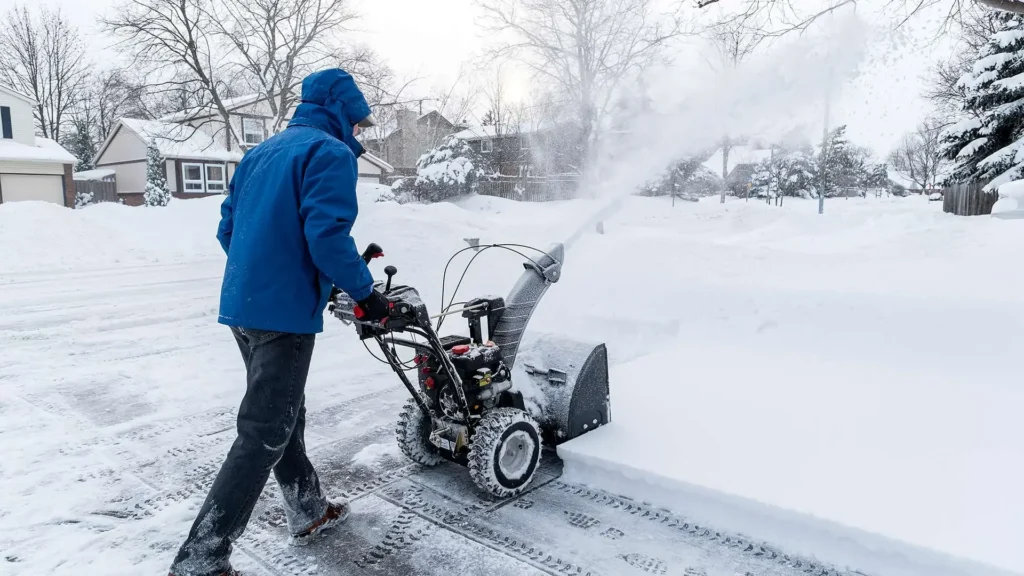
If you walked out after a chinook melt and found long pale gouges across your driveway, chipped corners where the slab meets the curb, or a scraped-away strip right down the middle, you are not imagining it. Blade damage shows up in Calgary exactly when the snow leaves, because that is the first time anyone can see the concrete again.
The frustrating part is that the damage is visible months after whoever caused it has gone. So before you start phoning for repair quotes, work through the question of responsibility in the right order. Done properly, this takes about ten minutes and can change who writes the cheque.
Start with one question: who was holding the blade?
Everything follows from this. There are only three realistic answers in a Calgary residential neighbourhood, and each one has a completely different path.
- A contractor you hired — a snow clearing service on a seasonal contract, or a one-off. This is the most common cause of driveway blade damage, and the strongest position you can be in.
- A City vehicle — a plow, grader or sander operating on your street or the public walk in front of your home.
- Nobody, in the legal sense — the damage is frost, settlement, or surface deterioration that was already underway and only became visible when the snow cleared.
Most people assume the second answer and start with the City. The odds say otherwise, for a reason worth knowing.
Why it is usually not a City plow
Calgary does not routinely plow residential streets. The City’s own snow plan is blunt about it: “The City does not typically clear snow from residential streets and works to maintain a hard snow pack.” The only residential work listed is “Levelling ruts in residential areas as needed,” and that comes in the last stage of the plan, after 36 hours.
The City’s priorities run in the opposite direction from your street. The first 18 hours go to the busiest routes. Pedestrian infrastructure — pathways, City-owned sidewalks, bridges and roughly 1,300 high-use bus stops — gets attention within 24 hours of snowfall stop time. Community and transit routes carrying more than 5,000 vehicles a day come next, between 18 and 36 hours.
So unless you live on a bus route or a connector, a City blade probably never came near your driveway. The equipment that did was almost certainly the one you paid for.
One more point that catches people out: the ridge of snow left across the end of your driveway after a street is plowed — a windrow — is yours to deal with. “Property owners can clear windrows created by plows for easier access,” and “The City does not undertake windrow clearance but crews make every effort to reduce their size.” That is an inconvenience, not damage, and it is not a claim.
If a City vehicle did it: what the City needs from you
Report it immediately, and gather the evidence before you do anything else. The City is explicit that the burden is on you: “It is your responsibility to provide us with evidence or proof of your loss.”
For damage caused by a City vehicle, the City asks for specifics most people never think to collect in the moment:
- The City’s identification number, which is located on the rear and side of the vehicle
- The licence plate, or the driver’s name if you can get it
- Witness names
- Photographs of the location and the damage
- The date and time of day
If you can, leave the damage alone: “If possible keep damaged property available for inspection.”
The claim itself goes in on a Notice of Claim Form, form L716, and a witness statement uses form L630. Then set your expectations honestly, because the City does: “Making a claim does not guarantee payment,” and compensation follows only “if and when negligence against The City has been proven.”
Timing matters more than most homeowners realize. The City’s published notice periods for other claims run as short as seven days, with 21 days for slip-and-fall on City sidewalks and 30 days for potholes and utility cuts. Those deadlines are written for those claims rather than for vehicle damage to a driveway, but the pattern tells you what you need: this is a system that works on short clocks. Report in days, not in spring.
If you hired the contractor: the contract is the claim
This is the better position, and it is the one most people under-use.
Start with what you agreed to. A seasonal snow clearing agreement normally says something about equipment, about what will and will not be cleared, and sometimes about damage to hard surfaces. Read it before you phone, because it determines whether you are having a conversation about an obligation or a favour.
Then ask three questions, in this order:
- Are you insured, and will you report this to your insurer? A legitimate operator carries liability coverage for exactly this. Asking plainly, early, and in writing changes the tone of the whole exchange.
- What equipment was on my driveway? A steel cutting edge on a plow blade gouges concrete. Rubber or polyurethane edges, and skid-steer buckets kept level, generally do not. The answer tells you whether the damage was predictable.
- Will you repair it or credit it? Many operators will settle a single slab or a corner rather than lose a customer and a reference.
Put all of it in writing, even if the conversation was friendly. An email summarizing what was said, sent the same day, is the record that matters if this goes further.
If the operator was clearing for a condominium or townhouse complex rather than for you personally, the contract is between the corporation and the operator, and your route runs through the board or property manager rather than directly.
Is it really blade damage? How to tell
This matters, because the wrong diagnosis sends you chasing a claim that was never going to land. Blade damage has a specific signature.
| What you see | Most likely cause |
|---|---|
| Long straight gouges or scrape lines, often parallel, with sharp bright edges | Blade contact |
| Chipped or broken corners at the curb, apron or garage slab edge | Blade or bucket impact |
| Flaking or peeling of the surface layer over broad patches | Surface deterioration, not impact |
| A slab lifted or dropped relative to its neighbour, with a step across a joint | Ground movement over the freeze season |
| Cracks that follow a straight line across the slab in a regular pattern | Joint behaviour, usually by design |
Fresh blade damage has clean, light-coloured edges because the break is new. Deterioration that has been working for a few winters has rounded, weathered, dirty edges. If the edges are dirty, it predates this season, and no claim will survive that detail.
Surface flaking has its own causes and its own fix, which we walk through in our guide to concrete spalling repair. Straight-line cracking across a slab is usually doing its job rather than failing — our guide to control joints explains where those lines are supposed to be.
What you are allowed to do with the snow yourself
Two rules are worth knowing, because getting them wrong invites a complaint while you are busy pursuing one.
You have one day: “Property owners must clear sidewalks within 24 hours post-snowfall,” and “Private property owners/occupants clear the sidewalk/pathway bordering their property.”
And direction matters. You may “Shovel snow from public spaces (e.g., sidewalks) onto other public spaces (e.g., roads),” but you may not “Shovel snow from private property (e.g., driveways) onto public spaces.” Piling your driveway snow into the street is not permitted, however tempting the open road looks. Also worth noting: “No one is required to clear walkways between homes.”
A ten-minute documentation routine
Do this the day you notice the damage, regardless of who you think caused it.
- Photograph each damaged area twice: one wide shot showing where it sits on the driveway, one close shot showing the edge of the break.
- Put something in the close shot for scale — a tape measure, a coin, a glove.
- Photograph the whole driveway from the street as well, so there is a record of what is not damaged.
- Note the date, and the date of the last clearing visit you can recall.
- Save the photos somewhere with a timestamp you did not create yourself.
- Keep any invoice, text message or email about the clearing work.
If nobody accepts responsibility and the amount justifies it, Alberta’s Court of Justice handles civil claims up to a limit of $100,000, and a filed claim must be served “within one year after the date that the Civil Claim is filed.” For a driveway, that is a last resort rather than a plan, but it is the backstop that makes the earlier conversations serious.
Repair, resurface, or live with it
Blade damage is usually cosmetic and local, which is good news.
- Shallow gouges and scrapes in otherwise sound concrete are a surface problem. The slab is not structurally affected, and the honest answer is often to leave it alone until you are doing other work.
- Chipped edges and corners can be rebuilt. The repair is visible if you look for it, because new material never matches weathered concrete exactly.
- Widespread surface scarring across a driveway that is otherwise solid is the case where concrete resurfacing makes sense, since it treats the whole surface instead of patching a dozen marks.
- Deep gouges that have exposed what is beneath the surface should be closed before another freeze season, because open damage collects water.
Timing is seasonal. Repairs need reasonable temperatures to bond and cure properly, so damage found in February is usually a spring job. Protecting what you have through the rest of the winter is covered in our winter concrete maintenance guide.
Get a Straight Answer and a Fair Number
Here is the part most companies will not put in writing: a good share of the damage we are called out to look at in March is not worth repairing this year, and some of it is not anyone’s fault. We will tell you that on the spot rather than quote you for work you do not need.
What we will do is tell you what caused it, whether the edges say it is recent, and what it would actually cost to fix properly if you decide to. If the answer is “wait until July and watch it,” that is the answer you will get.
Calgary Concrete Services is a division of Omega 2000. If you want a look at blade damage before you call your snow contractor back, or you are weighing a repair against replacement, see our concrete driveways page or get in touch for an assessment.
Frequently asked questions
Will the City pay to fix my driveway if a plow damaged it? Only if negligence is proven. The City states plainly that making a claim does not guarantee payment and that compensation follows if and when negligence against the City has been proven. Collect the vehicle identification number, plate, photographs, date and time, and report right away.
My street never gets plowed. Who damaged my driveway then? Most likely the service you hired. Calgary does not typically clear residential streets, and residential work is limited to levelling ruts as needed in the final stage of the snow plan.
Does my snow contractor have to repair damage they caused? That depends on your agreement and on their insurance. Ask in writing whether they are insured and whether they will report the damage to their insurer, and keep a same-day record of the conversation.
Who clears the ridge of snow across the end of my driveway? You do, if you want it gone. Property owners may clear windrows created by plows, and the City does not undertake windrow clearance.
Can I shovel my driveway snow onto the street? No. Snow may be moved from a public space such as a sidewalk onto another public space such as a road, but not from private property onto a public space.
How long do I have to report damage? Days, not months. The City’s notice periods for other claim types run as short as seven days, and for private contractors the practical limit is how long anyone can reliably say when the damage appeared.
Sources
- City of Calgary, Clearing sidewalks and shoveling snow — https://www.calgary.ca/bylaws/snow-shovelling.html
- City of Calgary, Damage claims and witness statements — https://www.calgary.ca/appeals/damage-claims.html
- City of Calgary, Seven-Day Snow Plan and plowing priorities — https://www.calgary.ca/roads/conditions/sanding-plowing-priorities.html
- Alberta Courts, Filing a Civil Claim (Alberta Court of Justice) — https://albertacourts.ca/cj/areas-of-law/civil/claims/filing