


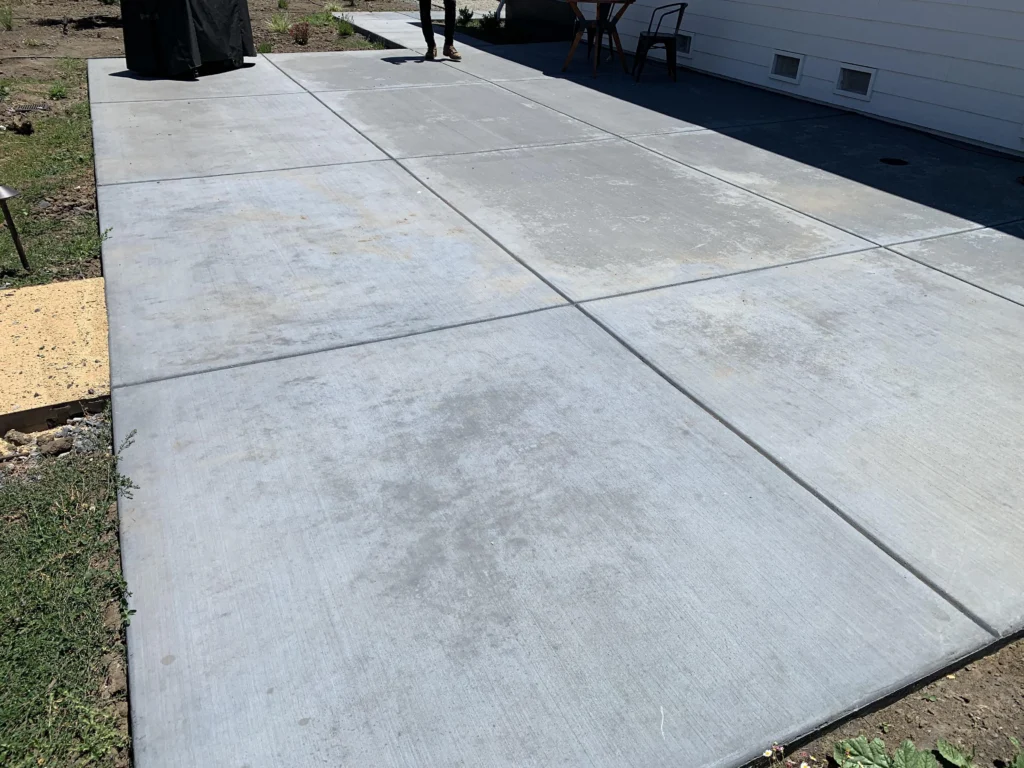
If your new driveway or patio has come out patchy — dark blotches, pale streaks, one half a different shade from the other — the most likely answer is discolouration, and it is a surface appearance problem rather than a structural one. The slab is almost certainly as strong as it should be. It just does not look like the even grey you were picturing.
That is cold comfort when you are standing on it. So here is the honest version: why concrete does this, which kinds fade and roughly how long that takes, which kinds do not, and what your options are if you have waited and it is still there.
We are a division of Omega 2000, and a fair share of our spring calls are homeowners asking whether a blotchy slab is worth fighting about. Sometimes it is. Usually it is something to wait out. Here is how to tell which you have.
First, make sure it is discolouration and not something else
Three different complaints get called “my concrete looks bad,” and they need completely different responses.
| What you see | What it probably is | Does it matter? |
|---|---|---|
| Dark blotches, mottling, patches, two-tone areas | Discolouration | Cosmetic |
| A white chalky film that rinses off and comes back | Salt deposits working their way out of the slab | Cosmetic, though repeat appearances point to a drainage problem |
| The surface flaking, chipping or pitting, with rough stone showing | Spalling | Real damage — needs attention |
This article is about the first row. If the surface is coming apart rather than changing colour, our spalling repair guide is the one you want.
A quick test: run your hand over the dark area. If it feels exactly like the lighter concrete beside it — same texture, same hardness, nothing loose — you are looking at colour, not damage.
What actually causes it
Concrete gets its colour from the cement paste at the very top of the slab. Anything that makes that thin surface layer denser, wetter, drier or chemically different in one spot shows up as a colour difference. On a residential job in this city, these are the common causes.
Uneven curing. This is the big one. If part of a slab stays damp and part dries out — a corner in shade, an area a tarp did not reach, a section the sun hit first — those areas hydrate at different rates and set to different shades. It is the most frequent cause of the classic “one end darker than the other” look.
Hard troweling, or troweling at the wrong moment. Working the surface harder in one area compacts and darkens it. Getting on it too early does the opposite and leaves it pale. On a big slab, the finishing crew is racing the set across the whole pour, and a section worked at a different stage than its neighbour will show.
Water added at the surface during finishing. Sprinkling water on a slab to make troweling easier changes the balance of water to cement right at the top. It is one of the shortcuts that produces both pale patching and, later, a dusty surface.
A set-accelerating salt that did not fully dissolve. In cool weather an accelerator is sometimes added so the concrete sets in a reasonable time. Where flake material does not dissolve completely, it leaves dark mottling behind. This is a well-documented cause and one of the harder ones to shift.
A change in materials mid-pour. Different batches, a different cement source, or supplementary materials in varying amounts all shift colour slightly. Concrete with a high-carbon ash content tends to darken.
Plastic sheeting laid on fresh concrete. Condensation collects under the plastic unevenly, and the slab dries to match — sometimes leaving a literal imprint of the wrinkles.
Notice the theme: almost everything on that list happens on pour day or in the week after. By the time you notice the colour, the cause is already history — which is why the prevention section below is the useful part if you have not poured yet.
Calgary makes this more likely than a milder climate does
Three local realities stack the odds.
Our pour season is compressed and the weather inside it swings hard. A slab poured on a 26°C afternoon that drops to 4°C overnight has cured under two quite different sets of conditions in twelve hours. Even colour comes from even conditions, and that is exactly what a Calgary shoulder season does not provide.
Heat shortens the crew’s finishing window. The trade association’s hot-weather guidance makes the mechanism plain: concrete sets faster as temperature climbs, and finishing has to happen at a faster rate to keep up. Their figures run from roughly fourteen hours to initial set at cool temperatures down to about two hours at the hot end. Squeeze that window and the odds of one area being worked at a different stage than its neighbour go up sharply.
Our wind dries surfaces unevenly. A dry chinook pulls moisture out of exposed areas far faster than sheltered ones. Same slab, two drying histories, two shades.
None of this makes a blotchy slab acceptable. It does mean some colour variation on a big pour in variable weather is a normal outcome rather than proof someone erred. Our guide to pouring concrete in extreme heat or cold covers what a crew is managing on those days.
What fades, what doesn’t, and how long to wait
This is the question everybody actually wants answered.
It often does fade, at least partly. The trade guidance is careful here — some types of discolouration fade with wear and age. Sun, rain, foot traffic, tires and a Calgary winter all work on the surface, and the contrast between light and dark areas softens.
Some of it disappears entirely. A greenish-yellow cast, the sort that sometimes shows on walls after the forms come off, goes away on its own with exposure to air and sunlight. If that is what you have, do nothing.
Some of it is permanent. Mottling from undissolved accelerator, and colour differences caused by materials changing mid-pour, are in the slab rather than on it. Those will not weather away.
The practical rule we give people: give it a full year before you spend money on it. One complete cycle of summer sun, autumn rain, winter freeze-thaw and spring melt does more to even out a surface than anything you can buy. If it still bothers you after that season, then it is worth treating.
Waiting also protects you from the most expensive mistake available here, which is the next section.
The one mistake that makes it permanent
Do not seal a slab you are unhappy with.
A film-forming sealer puts a clear layer over whatever is underneath. Seal a blotchy slab and you have locked the blotches in — and now fixing it means stripping the sealer first, which costs more than the sealing did.
Sealing is worth doing. It is just worth doing in the right order: let the slab go through its first season, see what the colour settles into, clean it, and seal once you are happy. If and when you get there, our comparison of penetrating versus film-forming sealers for the Calgary climate explains which type suits which surface, and why the glossier option is less forgiving on a slab that still has moisture moving through it.
If you have waited and it is still there
Options, cheapest and gentlest first.
1. Repeated hot water washing. Flush the area with hot water, scrub it, let it dry overnight, and repeat. Slow and unglamorous, but it lifts a surprising amount and it cannot damage anything.
2. A weak acid wash. The published remedial concentrations are low for a reason — around 1% for the strong acids, around 3% for the milder ones such as white vinegar or phosphoric acid. Whatever is used, the slab has to be dampened first and flushed with clean water within fifteen minutes.
3. A diammonium citrate treatment. The specialist option for stubborn discolouration: a 20% to 30% solution, roughly a kilogram in four litres, brushed onto a dry surface and left about fifteen minutes before scrubbing and rinsing. It needs a minimum of 72 hours of wet curing afterward, which is why it is not a Saturday job.
Three warnings, and we mean them. Test any chemical treatment on a hidden patch first, because these can permanently change your concrete’s colour and turn one problem into a worse one. Wear proper eye and skin protection — these products burn. And do not let runoff reach your lawn, your garden beds or a storm drain.
4. Accept it, or change it deliberately. If the colour will not even out and you do not want to live with it, the honest answer is that you stop fighting for uniform grey and choose a finish instead. Concrete staining is the usual route — a deliberate colour hides variation that no amount of washing will, and it tends to cost far less than replacing a structurally sound slab. Tearing out good concrete because of its colour is almost never the right call.
If you have not poured yet, this is the part that matters
Prevention is cheap and correction is not. Worth raising with whoever is quoting your job:
- Ask how the slab will be cured, specifically. Curing should run three to seven days, with the concrete kept above 10°C, and in cold weather it should not cool faster than about 3°C per hour for the first 24 hours. A crew that has a clear answer has thought about it. (Curing is not only a colour issue — concrete left to dry out can lose as much as 50 percent of its potential strength.)
- Ask that the whole slab be cured the same way. Uniform treatment is the single biggest lever on uniform colour.
- Ask for no water on the surface during finishing.
- Ask whether the pour is coming from one batch or several, and whether anything is being added for cold weather.
- Book realistic weather if you can. A stable stretch beats a dramatic one, and the difference shows up in the finished surface.
FAQ
Is discoloured concrete defective? Generally no. Uneven colour is a surface appearance issue and does not indicate the concrete is weak or failing. Damage looks different — flaking, pitting, a surface coming apart rather than changing shade.
Will blotchy concrete even out over time? Often, partly. Some discolouration fades with wear and age, and certain casts disappear entirely with exposure to air and sunlight. Mottling caused by undissolved accelerator or by materials changing mid-pour usually will not.
How long should I wait before doing anything about it? Give it a full year. One complete Calgary weather cycle does more than any treatment, and anything you apply before then may be fixing something that was going to resolve itself.
Can I pressure wash the dark patches off? Pressure washing does little for discolouration that is part of the cement paste. Repeated hot water washing with scrubbing is gentler and often more effective.
Should I seal it to even out the colour? No — sealing a slab you are unhappy with traps the appearance under a layer you then have to strip. Wait until the colour has settled and you are satisfied, then seal.
My driveway is two completely different shades where the crew stopped and restarted. Is that normal? A visible line at a cold joint or between batches is common and usually softens over a season. If it stays stark after a full year, staining is the practical fix.
A straight answer on whether yours is worth worrying about
Most blotchy slabs we get called out to look at are fine, and the right advice is to wait a season and then decide. The difference is usually whether the surface is intact: colour is cosmetic, a surface coming apart is not.
If you cannot tell which you have, we are happy to come and say so plainly — including when the answer is that there is nothing to fix. Start with concrete driveways, and if you would rather choose the colour than wait for it, concrete staining is where that conversation goes.
Sources
- NRMCA, CIP 23 — Discoloration: https://www.nrmca.org/wp-content/uploads/2021/01/23pr.pdf
- NRMCA, CIP 11 — Curing In-Place Concrete: https://www.nrmca.org/wp-content/uploads/2021/01/11pr.pdf
- NRMCA, CIP 12 — Hot Weather Concreting: https://www.nrmca.org/wp-content/uploads/2021/01/12pr.pdf