

If water sits on your driveway after it rains, the slope is wrong. In Calgary, a driveway or other hard surface is expected to fall at least 2% away from the garage door or the house wall — that is about 2 cm of drop for every metre, or roughly a quarter-inch per foot. Anything flatter and water has no reason to leave.
That sounds small. It is small. It is also the single most common thing we find when a homeowner calls us about a puddle that never goes away, and it is the reason a driveway that looked perfect in July is a sheet of ice in January.
Here is what the City actually requires, how to check your own driveway in ten minutes, and what the realistic fixes are — including the ones that are not “tear it all out.”
The short answer: the slopes your property needs
The City of Calgary sets these out in its lot grading guidance. You do not need to memorize them, but knowing the numbers tells you whether what you are looking at is a real problem or just a wet day.
| Where | Minimum slope | What that looks like |
|---|---|---|
| Driveways and hard surfaces, away from the garage entrance or house wall | 2% | About 2 cm of fall per metre |
| Ground within 1.2 m of a foundation wall | 4% | 4.8 cm of fall across that 1.2 m |
| Grassed or landscaped areas, and grassed swales | 2% | About a quarter-inch of fall per foot |
| Concrete swales (the shallow drainage channels between properties) | 0.6% | A very gentle but deliberate fall |
| Maximum slope without a retaining wall | 33% (3:1) | 1 m of drop over 3 m |
A “swale” is just a shallow trough shaped into the ground to carry water along a property line and out to the lane or street. If you have one, it is doing a job, and it is not a place to put a shed.
Why water pools on a driveway that looks flat
Almost every pooling problem we see comes down to one of four things, and only one of them is the concrete itself.
- It was poured flat. The most common cause. Either the forms were set without checking fall, or the slope was there but too little of it. At 1%, a driveway drains in theory and puddles in practice, because ordinary construction tolerances eat the difference.
- Something was added later. A new patio, a widened parking pad, a raised garden bed or a landscaping wall can dam the route the water used to take. The City’s guidance is explicit that grade and drainage have to be maintained when you install new landscaping or hardscaping — the obligation does not stop when the builder leaves.
- The ground under it settled. Poor compaction under the base, or backfill against the house settling over a few winters, tips a slab that was originally fine. This shows up as a low spot rather than a uniformly flat surface.
- The water was never supposed to go there. A downspout dumping straight onto the driveway will overwhelm a correct 2% slope every time.
It is worth separating “puddles” from “the slab is failing.” A shallow film that dries in a couple of hours after a heavy storm is normal — the City’s own drainage guide notes it can take up to two hours after a storm for ponded water to clear a low point. Water that is still there the next day is not normal.
What the City of Calgary actually requires
Calgary runs a Lot Grading Bylaw, and the phrase it uses is positive lot drainage. In plain terms, that means the land around your house has to be shaped so surface water flows away from the foundation and out to the street, the lane, or a swale — without dumping it onto your neighbour or onto City infrastructure.
Three things follow from that, and they surprise people:
- It is your responsibility, not the City’s. Once the home is built and the grades are certified, the property owner is responsible for establishing and maintaining positive lot drainage.
- It applies to your landscaping and hardscaping too. Pouring a patio, adding a walkway or replacing a driveway are all moments when drainage can be broken, and the rules expect you to keep it working.
- Blocking a drainage path is a bylaw issue. Blocked swales, blocked downspouts and blocked drainage routes are the specific examples the City gives.
If you are replacing a driveway rather than just repairing one, it is worth knowing where you stand on approvals too — our plain-English guide to when you need a permit for concrete work in Calgary covers that side.
Where your downspouts should be pointing
Downspouts are the cheapest drainage fix on any property and the most commonly ignored. The City’s guidance is straightforward: point them toward the front or back of the property so runoff can drain to the lane or the street, and never toward a permanent structure — including your neighbour’s house or garage.
Two numbers worth having:
- Extend the downspout at least 4 to 6 feet (1.21 to 1.83 m) from the foundation wall.
- Keep the discharge point at least 2 m away from public infrastructure such as sidewalks, streets, lanes and swales.
If a downspout currently empties within a foot of your foundation or onto the middle of the driveway, fix that before you do anything else. An extension costs less than a tank of gas and occasionally solves the whole problem.
Why this matters more in Calgary than elsewhere
Standing water on concrete is a nuisance in Vancouver. Here it is a durability problem, because of what our winters do to it.
Calgary does not have one long freeze. Chinooks mean we cross zero repeatedly all winter — the puddle melts in the afternoon, soaks into the surface, and freezes again overnight. Every cycle expands that water inside the top few millimetres of the slab. Do that a few dozen times a season and the surface starts to flake off in thin sheets. That is spalling, and once it starts it accelerates, because the roughened surface holds more water. We walk through what it looks like and when it can be repaired in our step-by-step guide to concrete spalling repair.
Add road salt tracked off the car into that puddle and it gets worse, not better. Our winter concrete maintenance guide covers what to use and what to keep off a driveway, but no de-icer strategy beats simply not having a pond there.
And there is the obvious one: a puddle at the bottom of a sloped driveway becomes an ice patch right where you step out of the car.
The ten-minute check
You do not need a survey to find out whether you have a slope problem.
- Wait for rain, or use a hose. Run water at the top of the driveway for five minutes.
- Watch where it goes. It should move steadily toward the street or lane. If it spreads sideways or stops, mark the spot.
- Measure the low spot. Lay a straight board across it and measure the gap underneath at the deepest point. More than about 10 mm of standing depth is a genuine birdbath.
- Check the first 1.2 m against the house. This is the critical zone, and it needs steeper fall than the rest — 4%. Water that sits here is the one that ends up in a basement.
- Look at your joints. Water sitting on a control joint will find its way under the slab. Our guide to control joints explains what those lines are and why they are not cracks.
Your realistic options
The right fix depends entirely on whether the slab is sound and how far off the grade is. In rough order of cost and disruption:
- Redirect the water. Downspout extensions, clearing a blocked swale, removing a landscaping feature that is damming flow. Sometimes this is the whole job.
- Regrade the ground beside the driveway. If water is running onto the slab from lawn or beds, the problem may not be the concrete at all.
- Lift and level the affected section. Where a slab has settled but is otherwise sound, raising it back to the proper fall is far less disruptive than replacement.
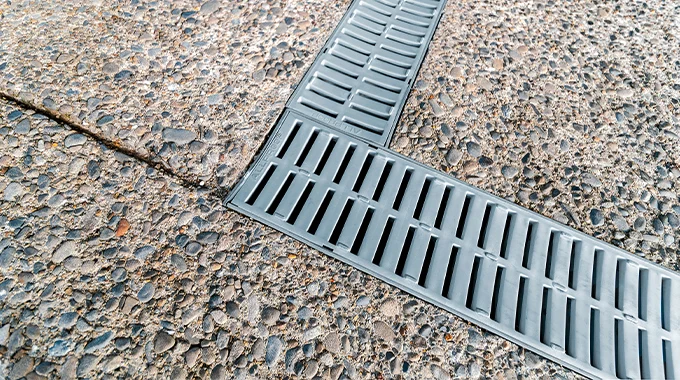
- Add a drain. A trench drain across the bottom of a driveway that slopes toward the garage can be the only real answer on a sloped lot — but it needs somewhere legal to discharge, which is where the 2 m rule matters.
- Replace the section, or the driveway. When the slab is spalled, cracked through, or was poured flat over a poor base, this is the honest answer. Rebuilding gives you the chance to set the fall correctly and compact the base properly.
On cost: we do not publish a number for drainage work, because the range is genuinely enormous — a downspout extension and a full driveway replacement are the same “problem” with a hundredfold difference in price. What drives it is square footage, how far out of grade you are, whether the base has to be rebuilt, and whether a drain and its discharge route are involved. Any contractor who quotes a drainage fix without walking the grade is guessing.
When it is your neighbour’s water
This comes up more than you would think on Calgary’s narrower lots. The City’s advice is to try to resolve it with your neighbour directly first; where that does not work, Calgary Mediating Services handles disputes between property owners, and a genuine bylaw infraction — a blocked swale, a downspout aimed at your wall — can be reported through 3-1-1.
Document it before you make the call. Photos during and after a rainfall, dated, are worth more than a description.
FAQ
How much slope does a concrete driveway need in Calgary? A minimum of 2% away from the garage entrance or the house wall, which is about 2 cm of fall per metre. Within 1.2 m of a foundation wall the requirement is steeper, at 4%.
Is it normal for water to pool on a new driveway? A thin film that clears within a couple of hours after heavy rain is normal. Water still standing the following day, or a measurable low spot of more than about 10 mm, is not — that is a grading issue rather than weather.
Can a driveway be fixed without replacing it? Often, yes. If the concrete itself is sound and the issue is a settled section, lifting and levelling it restores the fall without a tear-out. If the surface is spalled or cracked through, replacement is usually the better value.
Who is responsible for drainage on my property? You are. Under Calgary’s Lot Grading Bylaw, the property owner is responsible for establishing and maintaining positive lot drainage, including keeping swales and drainage paths clear.
Does adding a patio or widening a driveway affect this? It can, and the rules expect you to protect drainage when you do it. New hard surfaces shed far more water than lawn, and they can block the route water used to take. Plan the grade before the forms go in, not after.
How far should a downspout extend from the house? At least 4 to 6 feet (1.21 to 1.83 m) from the foundation, discharging toward the front or back of the property, and at least 2 m from sidewalks, streets, lanes or swales.
Get someone to look at the grade, not just the puddle
If you have water sitting where it should not, the useful next step is having someone put a level on it and tell you what is actually wrong — the slab, the base, the downspout, or the ground beside it. We are a division of the Omega 2000 team, we pour driveways across Calgary and the surrounding towns, and we would rather send you to the hardware store for a downspout extension than sell you a driveway you do not need. Have a look at our concrete driveway work or get in touch and we will come and check the fall.
Sources
- City of Calgary — Guide to Lot Drainage (Residential Development): https://www.calgary.ca/content/dam/www/uep/water/documents/water-documents/guide-to-lot-drainage.pdf
- City of Calgary — Lot Grading Tolerance Guidelines: https://www.calgary.ca/uep/water/water-and-wastewater-systems/storm-drainage-system/lot-grading-bylaw/lot-grading-tolerance-guidelines.html
- City of Calgary — Guidelines for Homeowners: Resolving a Lot Drainage Issue: https://www.calgary.ca/content/dam/www/uep/water/documents/water-documents/guidelines-for-homeowners-resolving-a-lot-drainage-issue.pdf