


Concrete is the same material in every town. What changes once you leave Calgary’s city limits is the ground it sits on, the paperwork, and how long the crew has to get there.
If you are planning a patio in Cochrane, Okotoks, Chestermere or Airdrie, here is what actually differs — and what does not.
The ground is not the same in each town
This is the part homeowners skip and regret in year three.
Cochrane sits higher and colder than Calgary, on slopes cut by the Bow. A patio on a Cochrane hillside lot needs a drainage plan before it needs a pattern. Water that runs toward the house instead of away from it will find the foundation long before it damages the patio.
Okotoks has its own groundwater behaviour along the Sheep River. A base that stays saturated through freeze-up moves. On the wrong lot, a slab that was flat in October is not flat in April.
Chestermere is flat, which sounds easier and often is — until you consider that flat means water has nowhere to go on its own. Grading has to be built in deliberately, and the lake proximity affects the water table on some lots.
Airdrie carries a mix of clay fills across newer subdivisions. Expansive clay under a patio behaves the same way it behaves under a garage slab: it lifts.
The practical instruction: do not accept a quote that has not looked at your ground. A patio priced off square footage alone is a patio priced without a base plan.
Base preparation is the whole job
The finish is what you look at. The base is what determines whether you are still looking at it in fifteen years.
A patio that lasts in this region needs:
- Organic material and topsoil removed completely — not levelled, removed
- Compacted granular base, thickness set by the soil, not by habit
- Positive slope away from the house across the whole surface
- Reinforcement appropriate to the span and use
- Control joints placed before the pour is planned, not after it cures
Everything above happens before a single cubic metre of concrete arrives. When a patio fails early in Alberta, it is almost never the concrete. It is the base or the drainage.
Permits and grading approval
Requirements differ by municipality, and they differ again depending on whether the patio is at grade, raised, attached to a deck, or changes the lot’s drainage.
A few general points that hold across the region:
- At-grade patios often do not require a building permit, but they can still be subject to lot grading rules.
- Anything that changes drainage — raising a surface, adding a retaining element, redirecting runoff toward a neighbour — is where towns pay attention.
- Setbacks from property lines vary by town and by zoning.
- Lots under an active grading approval (common in newer subdivisions) may require the final grade to be certified before or after work.
Cochrane, Okotoks, Chestermere and Airdrie each administer their own permits. Call the town office before you book a crew — it takes ten minutes and it is much cheaper than fixing it after.
Choosing a finish that survives an Alberta winter
Every finish looks good in a September photo. The question is what it looks like after five freeze–thaw cycles and a winter of de-icer.
Broom finish. The default for a reason. Good traction, lowest cost, easiest to repair. Unremarkable, but it does not fail.
Exposed aggregate. Excellent traction wet or dry, hides wear well, and the texture disguises minor surface aging. Our guide to what exposed aggregate concrete actually is covers the stone options and how the finish is achieved.
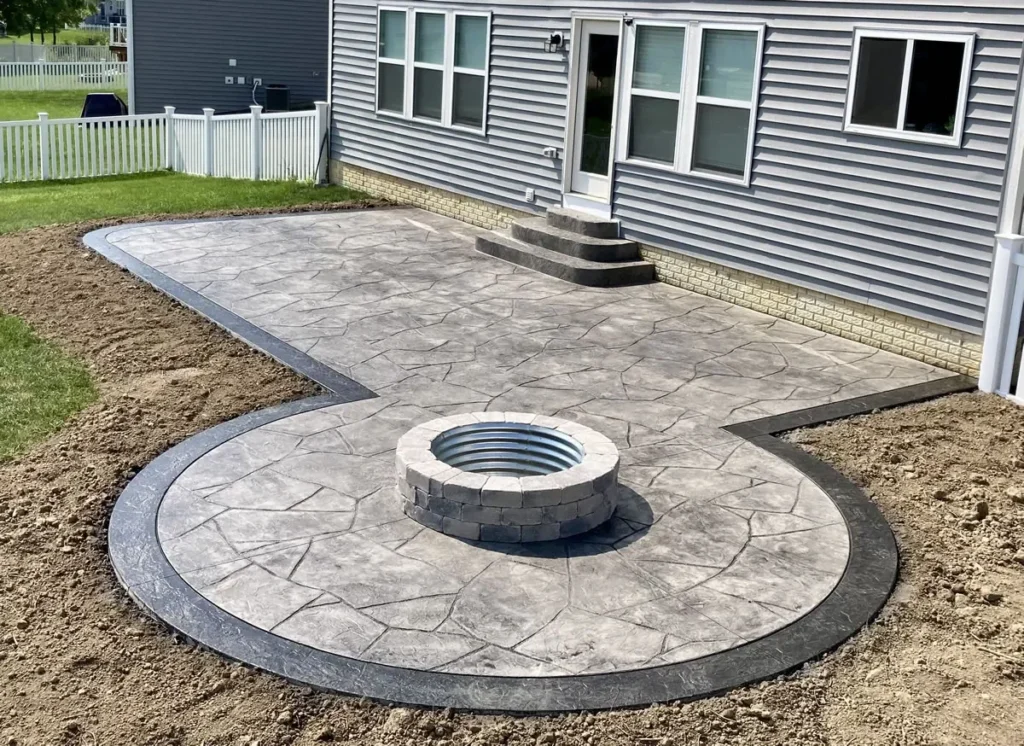
Stamped concrete. The most design flexibility and the most maintenance. It needs resealing on a schedule, and pattern choice matters more in a cold climate than most people expect — some patterns hold up considerably better than others. We covered the options in our guide to 25 stamped concrete patterns.
Coloured concrete. Integral colour ages more evenly than surface-applied colour under UV and freeze–thaw.
One rule that applies to all four: the sealer and the winter maintenance matter more than the finish choice. A well-sealed broom finish outlasts a neglected stamped patio every time.
Timing: when to book
Concrete in this region has a working season, and the shoulder months are where things go wrong.
- May to September is the comfortable window.
- Late April and October are workable with proper mix design and protection, but the finishing window shrinks and the cure needs managing.
- Hot chinook days are their own problem — the surface can set before the crew can finish it. Our post on pouring concrete in extreme heat and cold explains what changes in the mix and the schedule.
Practical advice for towns outside Calgary: book earlier than you think. Crews sequence work by geography to keep travel down, and out-of-city jobs get grouped. A patio in Okotoks booked in June may be poured in a different week than the same patio booked in Calgary.
What to have ready when you call
- Town and address
- Approximate dimensions
- Photos of the area, including where water currently drains
- Whether the lot has an active grading approval
- Access for a truck and a pump if needed
- Finish preference, or a request to be walked through the options
FAQ
Do you build concrete patios in Cochrane and Okotoks? Yes. Calgary Concrete Services works throughout the Calgary region, including Cochrane, Okotoks, Chestermere and Airdrie. Scheduling for out-of-city work is grouped by area, so booking earlier helps.
Do I need a permit for a concrete patio in Cochrane or Okotoks? It depends on the town, the patio type and whether it affects lot drainage. An at-grade patio often does not need a building permit, but grading rules and setbacks still apply. Confirm with your town office before booking.
How thick should a concrete patio be? Thickness depends on use and subgrade. Pedestrian patios and patios that will carry a hot tub or heavy furniture are not the same specification. The base under the slab matters as much as the slab thickness.
When is the best time to pour a patio in Alberta? May through September is the straightforward window. Shoulder-season pours are possible with the right mix and protection but need more care in finishing and curing.
Why do concrete patios crack? Some hairline cracking is normal in any concrete. Structural cracking is usually a base, drainage or joint-placement problem — the concrete is rarely the cause. Control joints are designed to let the slab crack where you want it to.
What finish lasts longest in a Cochrane or Okotoks winter? Broom finish and exposed aggregate are the most forgiving. Stamped concrete performs well when it is sealed on schedule; neglected, it shows wear faster than the alternatives.
Planning a Concrete Patio in Calgary or the Surrounding Area?
Don’t price your patio by square footage alone. Cochrane, Okotoks, Chestermere and Airdrie can have very different drainage, soil and access conditions, and those details determine what needs to happen underneath the concrete.
Send us your location, approximate patio dimensions and a few photos of the area. We’ll help you understand the right base preparation, drainage, concrete finish and timing for your property before the pour is scheduled.
Whether you’re building a simple broom-finished patio or a larger stamped or exposed-aggregate outdoor space, getting the preparation right is what makes the finished surface last through Alberta winters.
Ready to plan your patio? Request a concrete patio quote from Calgary Concrete Services and let’s look at the site before you book the pour.
Source
Town of Cochrane — use for current permit, development and lot-grading requirements.
Town of Okotoks — use for current building/development and drainage requirements.
City of Chestermere — use for current permit and property requirements.
City of Airdrie — use for current permit and grading requirements.
Environment and Climate Change Canada — use for Calgary-area climate data and temperature information.