


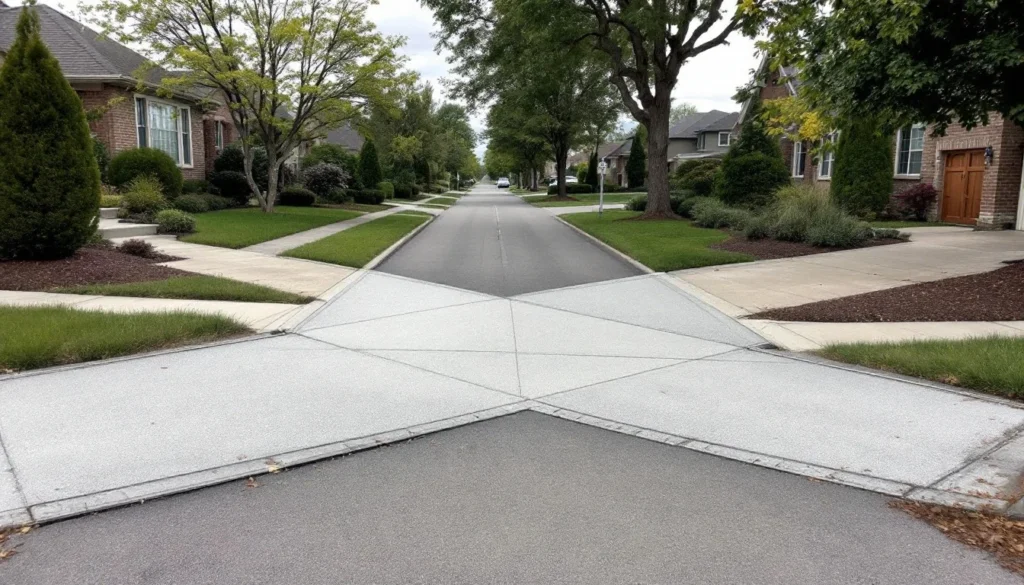
Your property probably does not end where your lawn ends. In most Calgary neighbourhoods, a strip in front of your house — the boulevard, the public sidewalk, sometimes a metre or two of what looks like your grass — belongs to the City. There is often a second invisible line running through the back or side of the lot, a utility right-of-way, where the City keeps access to pipes and cables even though you mow the grass over it.
When concrete crosses one of those lines, the City calls it an encroachment. Nothing dramatic happens the day it is poured. It usually surfaces years later, at the worst possible moment: you are selling, your buyer’s lawyer reads the survey, and somebody has to deal with it before the deal closes.
Here is how it actually works, what Calgary allows without any paperwork, and what you can check in an afternoon before you pour anything.
What an encroachment is
The City’s definition is broader than most people expect. An encroachment is “anything placed with a fixed location on the ground or attached to something having a fixed location on the ground that extends on, over, or under a City property or interest.”
In plain terms: if it is fixed in place and any part of it crosses onto City land, it counts. The City’s own list includes buildings, sheds, fences, driveways, sidewalks, decks, patios, pools, walls, trees and landscaping structures.
The City land it can cross includes more than the street:
- Streets — the road, the public sidewalk, boulevards, ditches, lanes and bridges
- Utility rights-of-way — strips reserved for water, sewer, electrical, telecommunications and transit
- Overland drainage rights-of-way — the grass swales and drainage structures that move stormwater between properties
- Parks — playgrounds, pathways, sports fields, natural areas
- Reserve land — Municipal, Environmental and School Reserve
- Other City-owned land that is not park
Two of those matter most for ordinary concrete work. Front driveways and walkways reach the street. Back and side pads, pathways and small walls land on utility or drainage rights-of-way. And encroachment onto reserve land is simply not permitted — that is one of the few hard noes in the whole document.
The number worth remembering: 0.34 metres
Calgary does not treat every overhang as a problem. The City’s guidelines set out a Schedule A list of encroachments that need only a consent letter, or nothing at all, and the general allowance for City-owned land that is not park is 0.34 metres. Cross by less than that, and you are in consent-letter territory. Cross by more, and you need a full encroachment agreement.
Schedule A also covers some specific cases that come up constantly on residential concrete:
| What it is | What Calgary allows without a full agreement |
|---|---|
| Front driveway or walkway providing access to the dwelling | Up to 2.0 metres in width |
| Steps | Up to 2.0 metres in width |
| Fence | Encroaching 0.34 metres or less, or to the back of the sidewalk |
| Wall | Not more than 0.24 metres in height |
| Non-permanent structures | 0.34 metres or less |
Past 3.0 metres of encroachment into City land or streets, you leave the encroachment process altogether and end up negotiating a licence of occupation with the City’s leasing group — effectively renting the land. That is rare for a driveway and common for a large parking area on a corner lot.
A note on how the City words the driveway allowance: it is a width limit on the access, not a general permission to pave the boulevard. Widening a driveway toward the lane or the sidewalk is exactly the sort of change that pushes a compliant access over the line, and it is worth measuring before the forms go in rather than after. It is also a different question from whether the work needs a permit at all, which we cover separately in our guide to when you need a permit for concrete work in Calgary.
How to find out, for free, today
You do not need to guess. The City’s own advice is to start with your Real Property Report — the survey drawing that shows your legal property boundaries and where structures sit relative to them. If you bought your house in the normal way, there is probably one in your closing file.
If the drawing shows your driveway, walkway or wall crossing a boundary line, you have an encroachment. If it does not show the structure at all — because you added it after the survey was done — then the drawing tells you where the line is, and you can measure from there.
Two caveats worth knowing before you spend money:
- Your property line and the back of the public sidewalk are not the same thing. There is frequently City land between them.
- A utility right-of-way does not look like anything. It is a registered interest, not a fence line, and it shows on your title and on the survey rather than on the ground.
You can pull a current copy of your title through Alberta’s land titles system using your legal description, your LINC number or your title number, through a registry agent or the province’s online services. That is also where any registered encroachment agreement will show up, which brings us to the part that matters at sale time.
What an agreement actually commits you to
If the City authorizes the encroachment, the agreement “shall be registered by caveat on the certificate of title to the owner’s land.” A caveat is a notice registered against your title — it does not take your land away, but it is visible to anyone who searches the title, and it travels with the property to the next owner.
Along with that come obligations that are worth reading before you sign:
- You carry all the risk. The guidelines put it bluntly: all expenses, costs, liabilities or other risk associated with both authorized and unauthorized encroachments are borne by the owner. If a visitor trips on the part of your walkway that sits on City land, that is still your concrete.
- You cannot expand it. An authorized encroachment cannot be added to, rebuilt or structurally altered, except as needed to remove it or for routine maintenance. Replacing a cracked section is maintenance. Extending the pad is not.
- It can be called in. The City can request removal of an authorized encroachment on thirty days’ notice to the owner.
- Removal is on you, and it has to be proven. All encroachment removals require the owner to submit an updated Real Property Report to the City showing the removal.
- There may be extra property tax. Owners with authorized encroachments into City-owned land and streets may be assessed additional municipal property taxes.
- If a utility has to be moved, the relocation cost is the owner’s responsibility.
If you decline to enter into an agreement, the City’s position is straightforward: you are required to remove the encroachment. Unauthorized encroachments must be removed by the owner within thirty days of a rejection or removal notice, and the City states that fines can range from $750 to $10,000 upon conviction.
What it costs
The City does not publish a single flat price, and we are not going to invent one. The structure of the cost is published: an application fee, plus an encroachment fee, plus GST, plus any additional municipal property taxes assessed on the encroachment. Certain Schedule A categories carry no fee at all. Single-family encroachments that predate July 1996 are charged the application fee only. If your application is denied, the encroachment fee is refunded and the application fee is not. Past the 3.0 metre threshold, where a licence of occupation applies instead, the City charges landscaping licence rates or a per-square-foot amount based on fair market value.
For a consent letter, the application package is specific: a signed application form with the terms and conditions initialled, the original Real Property Report carrying the City’s compliance stamp or a development permit stamp, a current copy of title, and payment through a CityOnline account. The consent letter is tied to that survey, and it ends when the encroachment is removed or when the City asks for removal.
The cheap version and the expensive version
The whole subject reduces to one habit. Before concrete goes in anywhere near the front line of the lot, the lane, or a right-of-way on the plan, somebody looks at the survey. That takes an afternoon and costs nothing. The expensive version is a saw, an updated survey to prove the removal, and a buyer’s lawyer setting the schedule.
This is also an argument for keeping the concrete you have in good shape rather than replacing and enlarging it. A section replaced in kind is maintenance. A slab that grew by half a metre during the rebuild is a new encroachment, and a new conversation with the City. Our guides to spalling repair for homeowners and winter concrete maintenance both land on the same point: the longer your existing concrete lasts, the fewer of these decisions you have to make.
Where this page stops
This page is about City land and the City’s encroachment process. It does not cover permits for concrete work, property-line disputes with a neighbour, surveys and what a Real Property Report is used for in a sale, restrictive covenants and builder architectural controls, condominium common property, or rental properties — each of those is a separate question and several have their own page on this site. Satellite towns outside Calgary run their own processes, so if your project is in Cochrane, Okotoks, Chestermere or Airdrie, check with that municipality; we touch on working in those communities in our page on concrete patios in Cochrane and Okotoks. This is general information, not legal advice.
Frequently asked questions
How do I know if my driveway is on City property? Start with your Real Property Report, the survey drawing that shows your legal boundaries. The City points homeowners to it directly. If the drawing shows concrete crossing a boundary line, you have an encroachment.
Is a small overhang automatically a problem? No. Calgary’s general allowance for City-owned land that is not park is 0.34 metres, and encroachments at or below that fall into the consent-letter category rather than requiring a full agreement. Encroachment onto reserve land is not permitted at any size.
Does an encroachment agreement show up on my title? Yes. An authorized agreement is registered by caveat on the certificate of title, and it binds whoever owns the property afterward.
Can the City make me tear out a driveway it already approved? It can request removal of an authorized encroachment on thirty days’ notice. Removal is at the owner’s cost, and you have to submit an updated Real Property Report proving it was done.
What happens if I just ignore it? Unauthorized encroachments must be removed within thirty days of a notice, and the City states fines can range from $750 to $10,000 upon conviction. It also tends to surface at sale, when you have the least time to deal with it.
Can my patio sit on a utility right-of-way? Most encroachments into a utility right-of-way need an encroachment agreement rather than a consent letter, and if the utility ever has to be relocated, that cost is yours. Check the right-of-way before you choose where the pad goes.
Check the line before you pour
If you are planning a new driveway, a wider approach, a walkway to the front door or a pad along the side of the house, the survey review takes an afternoon and saves the kind of problem that only shows up when you are trying to sell.
We are a division of Omega 2000, and we look at the property boundaries as part of planning the job, not as a surprise at the end of it. If you want a straight answer about where your concrete can and cannot go, get in touch through our concrete driveways page and have your survey handy — we will tell you what we see before anybody books a pour date.
Sources
- City of Calgary, Encroachment Guidelines — https://www.calgary.ca/content/dam/www/realestate/documents/encroachment/encroachmentguidelines-final.pdf
- City of Calgary, Encroachments — https://www.calgary.ca/realestate/encroachments.html
- City of Calgary, Encroachment Consent Letter application form (Schedule A) — https://www.calgary.ca/content/dam/www/realestate/documents/encroachment/encroachment-agreement-application-form-sch-a.pdf
- Government of Alberta, Find land titles, documents and plans — https://www.alberta.ca/find-land-titles-documents-plans